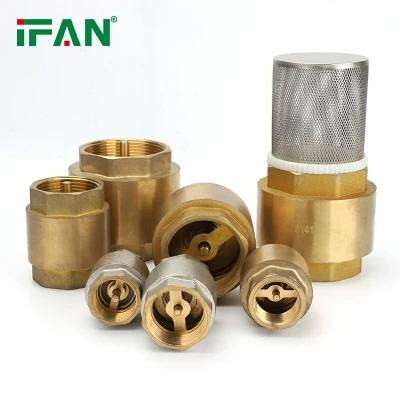


Non Return Valve Supports Water Supply Systems
Brand: IFAN
Materials:Brass
Size:1/2"-4"
Sample: Free Sample
Service: OEM&ODM
- Fast Delievery
- Quality Assurance
- 24/7 Customer Service
Product Introduction

| Product Name | Non Return Valve |
| Color | Brass or Sliver Color |
| Size | 1/2''-2'' |
| Brand | IFAN or Customized |
| OEM |
Support |
| Sample | Free |
| Experience | 30+Years |
Welcome to contact IFAN, we are online 24 hours a day to answer your questions!

The Role of Non Return Valves in Water Distribution
A water supply system involves more than transporting water from a treatment plant to homes, commercial buildings, and industrial facilities. Water must pass through a network of pumps, storage tanks, distribution pipes, and control equipment while maintaining the intended direction of movement. Because these components operate under different pressure conditions, controlling flow throughout the network is an important part of system design.
A non return valve, also known as a check valve, allows water to move forward while restricting reverse flow. It operates automatically according to the pressure difference across the valve, without requiring an operator to open or close it during every change in operating conditions. This makes it a practical component in many water supply arrangements.
From municipal distribution networks to building plumbing systems, non return valves help maintain the intended hydraulic arrangement between connected components. Their location and specifications depend on the purpose of each pipeline, the available pressure, and the possible consequences of reverse flow. Understanding these factors allows engineers to integrate check valves into water supply systems more effectively.
Maintaining Flow Direction in Distribution Networks
Water distribution networks contain numerous interconnected pipelines that deliver water to different service areas. Demand changes throughout the day as households, businesses, and industrial users draw water at different rates. These variations can cause pressure differences across the network, particularly when pumps start or stop or when major users suddenly increase consumption.
Under certain conditions, water may begin moving backward through a pipeline or toward a source that is not intended to receive returning flow. A non return valve helps restrict this movement by closing when the pressure conditions no longer support forward flow.
This function is particularly relevant in systems where water passes through several pumping stages or enters separate distribution zones. Check valves installed at appropriate locations help maintain the intended direction between sections and reduce unwanted circulation.
However, water networks require careful hydraulic planning. Engineers must consider the relationship between pipe diameter, elevation, demand, and pump performance before selecting valve locations. A check valve should support the designed flow arrangement rather than be used as a substitute for proper pressure management or network control.
Supporting Pumping Stations and Booster Systems
Pumping stations are commonly used to move water across long distances or deliver it to areas at higher elevations. Booster pumps may also be installed in tall buildings, remote communities, and facilities where the incoming supply pressure is insufficient for the required demand.
When a pump operates, it creates a pressure difference that moves water toward the discharge pipeline. Once the pump stops, water in the discharge line may return toward the pump because of gravity or pressure remaining elsewhere in the system. Uncontrolled reverse flow can interfere with the next pumping cycle and place additional mechanical stress on the equipment.
A non return valve installed on a suitable discharge connection restricts water from returning through the stopped pump. In a station containing several pumps, individual check valves can also help limit flow through inactive units when other pumps are running.
The valve must match the pump's capacity and operating characteristics. Its opening pressure and closing response affect the overall hydraulic behavior of the station. For installations with frequent pump starts and stops, engineers should also assess potential pressure surges and determine whether additional control measures are required.
Managing Water Storage Tanks and Elevated Reservoirs
Storage tanks and elevated reservoirs help balance supply and demand throughout a water distribution system. They may receive water during periods of low consumption and release it when demand increases. Because these storage facilities can operate at different elevations and pressure levels, the connected pipelines must be arranged carefully.
When the supply pressure falls, water stored at a higher elevation may flow backward through the filling line if suitable flow control is absent. This can disrupt the intended operation of the storage arrangement and affect connected pumps or distribution pipes.
A properly positioned non return valve helps restrict reverse flow from the storage facility toward the supply line. In building water systems, check valves may also be used in selected connections to control the direction of flow between equipment and the wider plumbing network.
The design must account for tank elevation, static pressure, expected filling rates, and possible changes in water demand. Engineers should also consider whether trapped water could expand as its temperature changes, since check valves can isolate sections of piping and create conditions that require separate pressure relief provisions.
Maintaining Separation Between Water Supply Zones
Large buildings and municipal networks may divide water distribution into separate pressure zones. This arrangement helps deliver water to users at different elevations without exposing every section of the system to the same pressure conditions.
Connections between zones require careful control because water may move toward a lower-pressure section when operating conditions change. Such movement can disturb the intended distribution arrangement and affect pressure regulation in neighboring pipelines.
Non return valves can help restrict flow from one section toward another when reverse movement is not intended. For example, a check valve may be installed in a branch supplying a particular piece of equipment to prevent water from returning through that connection when another section remains pressurized.
However, check valves do not independently regulate pressure or guarantee complete separation between zones. Pressure-reducing valves, isolation valves, and other control devices may be required depending on the system layout. The final configuration should follow applicable plumbing standards and water authority requirements.
Supporting Water Quality Control
Water quality must be protected throughout the distribution process, not only at the treatment plant. Reverse flow can introduce water from a storage vessel, process connection, or contaminated pipeline into a cleaner supply. This is a particular concern where drinking water systems connect to irrigation equipment, industrial processes, or chemical dosing arrangements.
A non return valve restricts the movement of water in the reverse direction at the connection where it is installed. Nevertheless, ordinary check valves may leak or fail to close completely, so they cannot automatically be considered sufficient protection against every contamination hazard.
Where potable water may be exposed to hazardous substances, the system may require a code-approved backflow prevention assembly or another method of physical separation. The required protection depends on the risk category, local regulations, and the nature of the connected equipment.
Regular inspection is also important. Sediment, scale, and debris can interfere with the valve's internal mechanism, while worn sealing surfaces may permit reverse leakage. Maintenance procedures should reflect the water quality and operating conditions of the installation.
Selecting and Maintaining the Appropriate Valve
Choosing a suitable non return valve requires an understanding of the complete water supply arrangement. Engineers should evaluate the required flow rate, operating pressure, pipe size, water temperature, installation orientation, and expected frequency of operation. The valve's pressure loss must also be considered to avoid unnecessary restrictions within the distribution network.
Different designs suit different applications. Swing check valves, lift check valves, and spring-assisted models respond differently to changes in flow and pressure. The selection should reflect the system's operating characteristics rather than relying solely on the nominal pipeline diameter.
After installation, technicians should check for leakage, abnormal noise, vibration, and unexpected pressure changes. Periodic functional testing helps confirm that the valve opens during forward flow and closes appropriately when reverse flow becomes possible.


Hot Tags: non return valve supports water supply systems, China non return valve supports water supply systems manufacturers, suppliers, factory, Brass Non Return Valve