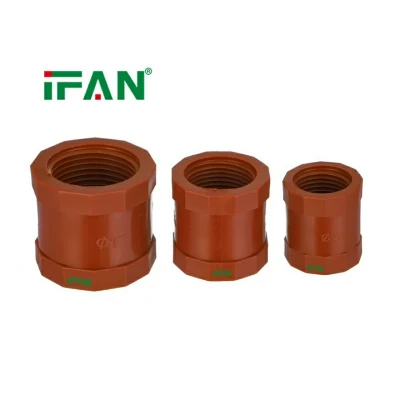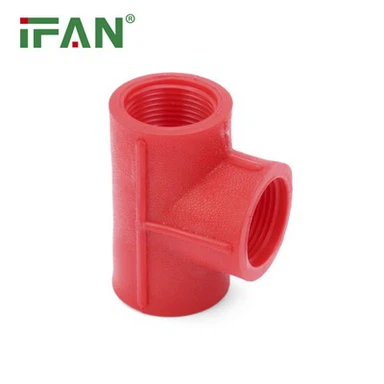

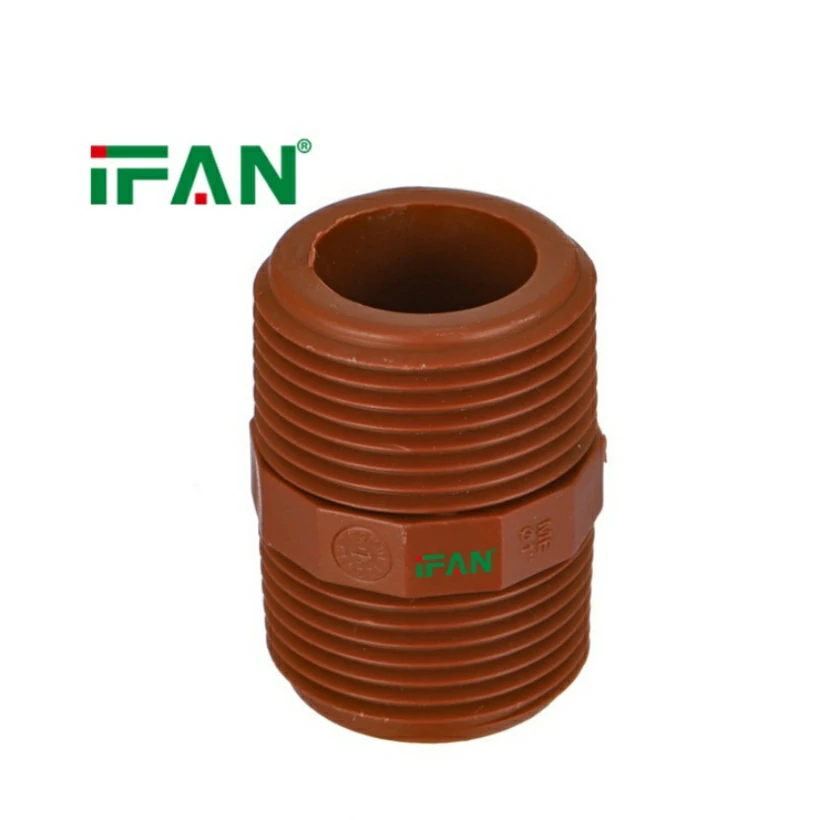


PPH Pipe Fittings Improve Flow Efficiency
Type:PPH Pipe Fittings
Brand:IFAN
Connecting method:Thread
Applications:Water Systems
Color:Brown
- Fast Delievery
- Quality Assurance
- 24/7 Customer Service
Product Introduction

| Product Name | PPH Pipe Fittings |
| Size | 1/2"-2" Or Customized |
| Color |
Brown Or Customized |
| Package | IFAN standard packaging |
| Connection | Thread |
| Sample | Sample Free |
| Contact |
Welcome to contact IFAN, we are online 24 hours a day to answer your questions!
How Fittings Influence Fluid Flow
Fluid does not move through a pipeline in a perfectly straight path. Elbows redirect the stream, tees divide it, reducers change its velocity, and couplings connect separate pipe sections. Every fitting therefore influences the way a fluid travels through the system. Choosing an appropriate fitting is important when the goal is to maintain a controlled and efficient flow path.
PPH pipe fittings are manufactured in configurations designed to correspond with PPH piping systems. Their internal passages provide a defined route for liquids and help connect different sections without relying on improvised transitions. When fittings are selected according to pipe size and system layout, the flow path can be planned with fewer unnecessary changes in direction or diameter.
Smooth Internal Surfaces
The condition of the internal fitting surface has a direct relationship with fluid movement. A relatively smooth polymer surface can provide a consistent passage for liquids, reducing the surface irregularities that can disturb the flow. This is particularly relevant in systems where maintaining predictable hydraulic behavior is important.
As fluid travels through a fitting, friction occurs between the moving liquid and the internal wall. The characteristics of the surface contribute to this friction. PPH fittings provide a smooth thermoplastic interior, which can help limit frictional effects compared with rougher internal surfaces. The actual pressure loss still depends on flow velocity, pipe dimensions, fluid properties, and the geometry of the fitting.
Managing Changes in Flow Direction
Elbows are necessary whenever a pipeline changes direction, but abrupt directional changes can increase local pressure losses. The geometry of an elbow influences how smoothly the fluid turns and how much turbulence develops around the bend.
Selecting the appropriate PPH elbow configuration allows designers to consider the direction of the pipeline without creating unnecessary deviations from the intended flow route. In systems where pressure loss is a concern, fitting geometry should be evaluated alongside pipe diameter and flow rate. The objective is not simply to install an elbow that fits physically, but to select a configuration appropriate for the required hydraulic conditions.
Properly Sized Reducers
Reducers connect pipes with different diameters and create a controlled transition between them. An unsuitable reduction can produce a sudden change in velocity and increase local flow disturbance. PPH reducers provide a purpose-designed transition between compatible pipe sizes.
The reducer should be selected according to the required upstream and downstream diameters as well as the expected flow conditions. A properly planned transition helps the system move from one pipe section to another without introducing an unnecessary change in geometry. In engineering calculations, the reducer should still be included as a source of local pressure loss rather than being treated as a zero-resistance component.
Branch Connections with Tees
Tees allow a main pipeline to connect with a branch line, making them common in distribution and process systems. Their geometry affects how fluid divides or combines at the junction. If the branch arrangement is poorly planned, the resulting changes in velocity and direction can create additional turbulence and pressure loss.
PPH tee fittings provide defined branch configurations for these situations. Engineers can select the appropriate size and arrangement according to the required flow distribution. The diameter of the branch, the direction of flow, and the expected operating rate should all be considered when designing a tee connection. Proper sizing helps prevent the fitting from becoming an unnecessarily restrictive point in the pipeline.
Reducing Unnecessary Flow Restrictions
A pipeline can lose flow efficiency when it contains too many fittings or when fittings are selected without considering their hydraulic characteristics. Every elbow, tee, valve connection, reducer, and other change introduces a degree of local resistance.
For this reason, efficient pipeline design begins with a practical layout. The routing should avoid unnecessary bends and excessive changes in diameter. PPH fittings can then be selected to match the required turns and branches. This approach helps create a flow path that is easier to analyze because each fitting has a clear purpose within the overall system.
Maintaining Consistent Pipe Dimensions
A well-matched connection helps maintain continuity between the pipe and fitting. If the transition between components is poorly matched, changes in internal geometry can disturb the flow and create additional local losses. Correctly specified PPH fittings are intended for compatible PPH pipe dimensions, allowing the connection to follow the designed pipeline geometry.
Dimensional consistency is particularly important at reducers, branches, and equipment interfaces. Before installation, the nominal diameter, fitting specification, and pipe dimensions should be verified. This simple step helps prevent mismatched components from creating unexpected restrictions within the flow path.
Designing for Hydraulic Performance
Improving flow efficiency requires more than selecting a pipe material. The complete hydraulic design must consider pipe diameter, flow rate, fluid viscosity, pressure requirements, elevation changes, fitting geometry, and the number of connection points. PPH fittings form one part of this calculation and should be included when estimating total system pressure loss.
Engineers can use fitting-specific loss coefficients or equivalent-length methods to account for local resistance. This makes it possible to compare different layouts and determine where unnecessary restrictions may occur. When fitting selection is coordinated with the hydraulic design, PPH pipe fittings can support a more predictable flow path and help maintain the pressure and flow conditions required by the process.


Hot Tags: pph pipe fittings improve flow efficiency, China pph pipe fittings improve flow efficiency manufacturers, suppliers, factory, PPH Fittings, PPH Pipe Fitting