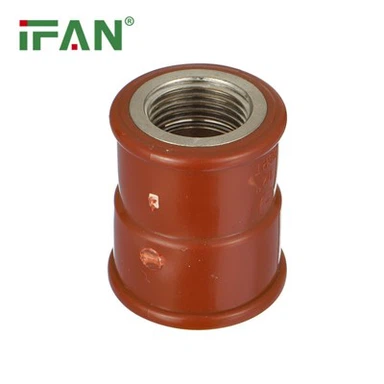


PPH Pipe Fittings Resist Scaling And Deposits
Type:PPH Pipe Fittings
Brand:IFAN
Connecting method:Thread
Applications:Water Systems
Color:Brown
- Fast Delievery
- Quality Assurance
- 24/7 Customer Service
Product Introduction

| Product Name | PPH Pipe Fittings |
| Size | 1/2"-2" Or Customized |
| Color |
Brown Or Customized |
| Package | IFAN standard packaging |
| Connection | Thread |
| Sample | Sample Free |
| Contact |
Welcome to contact IFAN, we are online 24 hours a day to answer your questions!
Understanding Scale and Deposit Formation
Scaling and deposits can gradually develop inside piping systems when dissolved minerals, suspended particles, or chemical residues accumulate on internal surfaces. Common examples include calcium-based scale, crystallized salts, process residues, and other deposits formed when fluid composition or operating conditions change.
Fittings can be particularly relevant because elbows, tees, reducers, and other components change the direction or velocity of the fluid. These changes may create local conditions where particles settle or dissolved substances precipitate. PPH pipe fittings provide a smooth polymeric internal surface that can be considered when designing systems where the control of deposits is an important operating requirement.
Smooth Internal Surfaces
The internal condition of a pipe fitting influences how easily material can remain attached to its surface. A relatively smooth PPH surface provides fewer pronounced surface irregularities than many rough or deteriorated internal surfaces. This can reduce locations where particles have an opportunity to become mechanically trapped.
However, smoothness does not mean that deposits cannot form. Scale formation is strongly affected by the chemistry of the transported fluid. If a solution becomes supersaturated with minerals, precipitation can occur regardless of the pipe material. The role of the fitting is therefore better understood as influencing the conditions under which deposits interact with the internal surface rather than completely eliminating scaling.
Reduced Interaction with Deposited Materials
When mineral crystals or process residues begin to form, the characteristics of the underlying surface can affect how strongly the material remains attached. PPH provides a non-metallic polymer surface that does not develop the same type of corrosion products associated with metallic piping.
This distinction matters because corrosion products can themselves become part of an internal deposit layer. In a metal system, surface oxidation and corrosion may introduce additional material into the flow path. PPH does not produce metallic rust, so this particular source of internal accumulation is absent from the fitting material.
Managing Mineral-Rich Water
Water containing dissolved calcium, magnesium, silica, or other minerals can create scaling conditions when temperature, pressure, or concentration changes. Heating is particularly relevant because some dissolved compounds become less soluble as temperature increases and may precipitate onto internal surfaces.
PPH fittings can be used in appropriate water-handling systems where scale control is required, but the water chemistry still needs to be managed. Treatment methods, filtration, temperature control, and flow conditions may all influence the amount of material available to form deposits. Material selection should therefore be combined with suitable water-quality management.
Fitting Geometry and Deposit Accumulation
The shape of a fitting can influence local flow behavior. Elbows redirect the fluid, tees divide or combine streams, and reducers change the cross-sectional area. Poorly selected configurations may create areas of low velocity where suspended solids can settle.
Using fitting dimensions that correspond correctly with the pipeline design helps maintain the intended flow path. Where deposits are a known concern, designers can consider the number of directional changes, branch connections, and diameter transitions. Reducing unnecessary changes can help limit locations where solids may accumulate.
Temperature and Precipitation
Temperature changes can have a significant effect on scaling. A process fluid that remains clear at one temperature may begin to produce crystals after heating or cooling. This is especially relevant in systems handling concentrated solutions or mineral-rich water.
When PPH fittings are used in such applications, the fitting material should be evaluated together with the process temperature. The system designer should identify where temperature changes occur and determine whether those areas are likely to promote precipitation. Keeping the operating conditions within the specified range helps create a more predictable environment for deposit control.
Controlling Suspended Particles
Not all deposits are created by dissolved minerals. Suspended solids, process particles, pigments, biological residues, and other materials can also accumulate inside piping. Their behavior depends on particle size, density, concentration, flow velocity, and fitting geometry.
PPH fittings can form smooth internal passages that allow appropriately sized particles to move through the system when the hydraulic conditions support sufficient transport. However, no fitting material can compensate for an unsuitable flow rate or excessive solids concentration. Filtration and process control may therefore be necessary where suspended material is present at significant levels.
Cleaning and Deposit Removal
Even when a piping system is designed to reduce accumulation, periodic cleaning may still be necessary. The cleaning procedure should be compatible with the PPH material and the type of deposit being removed. Acidic cleaners, alkaline solutions, or specialized chemical treatments should be evaluated before use.
Fitting design can also influence how easily a pipeline can be cleaned. Sections with unnecessary dead legs or poorly accessible connections may be more difficult to flush. A well-planned layout with appropriate fitting configurations can support more consistent movement of cleaning fluids through the system.
Designing Against Scaling and Deposits
PPH pipe fittings can play a role in systems where internal scaling and deposits need to be controlled. Their smooth polymer surfaces, non-metallic composition, and available fitting configurations provide a suitable basis for managing the internal flow path under appropriate conditions.
The final level of deposit control depends on more than fitting material. Fluid chemistry, temperature, flow velocity, solids concentration, fitting geometry, filtration, and cleaning practices all influence accumulation. By considering these factors together, engineers can select PPH fittings and design the pipeline in a way that limits unnecessary deposit formation and supports controlled internal flow conditions.


Hot Tags: pph pipe fittings resist scaling and deposits, China pph pipe fittings resist scaling and deposits manufacturers, suppliers, factory, PPH Fittings, PPH Pipe Fitting