


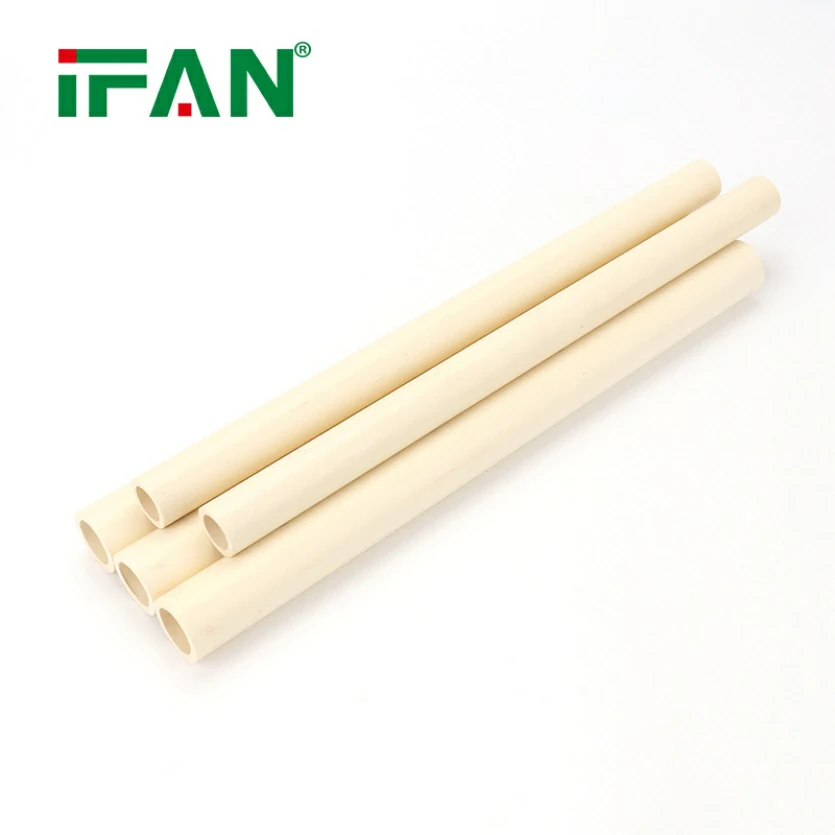

Leak Resistant PVC Pipe
1.CPVC Tubing is equally easy to install in confined or restricted areas.
2.Compared to other plastics, CPVC provides superior tensile strength and requires fewer hangers and brackets.
- Fast Delievery
- Quality Assurance
- 24/7 Customer Service
Product Introduction
| Product Name | IFAN CPVC Pipe |
| Size | 20-32mm Or Customized |
| Color |
White,Beige Or Customized |
| Package | IFAN standard packaging |
| Standard | DIN |
| Sample | Sample Free |
| Contact | Click HERE to contact us now! |
Welcome to contact IFAN, we are online 24 hours a day to answer your questions!

Understanding Leak Resistance in PVC Piping Systems
Leak prevention is an essential consideration in the design and installation of water supply, drainage, and industrial piping systems. Even a small amount of leakage can indicate problems with joint assembly, sealing materials, connection alignment, or operating pressure. For this reason, the performance of a piping system depends not only on the quality of individual pipe sections but also on the accuracy of every connection.
PVC (polyvinyl chloride) pipes are commonly used with specially designed fittings and joining methods to create sealed pipeline connections. Depending on the application, these systems may use solvent cement joints, rubber ring seals, threaded connections, or mechanical fittings. Each method follows a different sealing principle, but all require correct preparation and assembly. Understanding how these connection methods work helps explain how PVC piping systems control leakage under specified operating conditions.
Solvent Cement Joints Create Sealed Connections
Solvent cement joining is a common method used in many PVC pressure and drainage piping applications. Unlike conventional adhesive bonding, this process involves chemically softening the contacting PVC surfaces so that they can integrate during assembly.
When solvent cement is applied to the prepared pipe end and fitting socket, the surface layers become temporarily softened. The pipe is then inserted into the fitting to the specified depth. As the solvent evaporates, the contacting materials form an integrated joint.
The quality of this connection depends on several factors, including surface preparation, cement selection, application quantity, insertion depth, and curing time. Pipe ends should be cut squarely and cleaned before joining. Any dirt, moisture, grease, or irregular edges may interfere with proper contact between the connecting surfaces.
Using the correct solvent cement for the specific PVC pipe system is essential. Products should always be selected according to manufacturer instructions and applicable standards rather than treated as interchangeable materials.
Rubber Ring Joints Provide Controlled Sealing
Rubber ring joints are frequently used in PVC drainage, sewerage, and certain water transportation systems. This connection method relies on an elastomeric sealing ring positioned inside a specially designed fitting socket or pipe end.
During assembly, the spigot end of one pipe is inserted into the socket containing the sealing ring. As the pipe enters, the rubber component is compressed against the contacting surfaces, creating a sealing interface that restricts liquid movement through the joint.
Several details influence the effectiveness of this sealing arrangement. The sealing ring must be correctly positioned, free from visible damage, and compatible with the pipe system. The spigot end should also be clean and properly prepared. An approved lubricant may be required to support smooth insertion without displacing or twisting the sealing ring.
Uneven insertion or incorrect ring placement can create gaps along the sealing surface. Therefore, installers should check joint alignment and insertion depth according to the manufacturer's specifications.
Accurate Pipe Alignment Prevents Leakage
Pipe alignment is an important but sometimes overlooked factor in connection performance. When two pipe sections are connected at an incorrect angle, the joint may experience uneven contact pressure. This can interfere with the sealing arrangement and introduce unnecessary mechanical stress.
PVC pipes should be positioned according to the intended pipeline route before the final connection is completed. For straight sections, the pipe ends should remain properly aligned. Where the pipeline changes direction, suitable elbows and other compatible fittings should be used instead of forcing the pipe into an unnatural position.
Underground installations require particular attention because surrounding soil conditions can influence pipe positioning. Uneven bedding, localized settlement, and excessive external loads may cause movement around connection points.
Appropriate trench preparation and support arrangements help maintain the intended pipe alignment. Installation teams should also avoid applying excessive force during assembly, as this may damage sockets, sealing rings, or pipe ends.
Correct Cutting and Surface Preparation
A reliable PVC connection begins before the pipe is assembled. Cutting accuracy and surface preparation directly affect how the pipe interacts with its fitting.
Pipe sections should be measured carefully and cut at a right angle to the pipe axis. An uneven cut can produce inconsistent insertion depth or interfere with the contact between the pipe and fitting. After cutting, burrs and sharp edges should be removed using suitable tools.
For solvent cement connections, the surfaces must be prepared according to the specified joining procedure. Depending on the system, this may include cleaning and applying an approved primer. For rubber ring connections, the pipe end and sealing area should be inspected to ensure that no particles or sharp edges could damage the gasket.
These preparation steps help establish the correct contact conditions required for the selected connection method.
The Role of Operating Pressure in Leak Prevention
Operating pressure has a direct influence on the sealing requirements of a PVC piping system. Pressure inside a pipeline creates forces that act on the pipe wall, fittings, and joints. If the system operates outside its specified pressure limits, connections may experience excessive stress.
PVC pressure pipes are manufactured according to defined dimensional and pressure classifications. Compatible fittings must be selected to match the intended operating conditions. The pressure rating of the complete assembly should be considered rather than evaluating the pipe section independently.
Temperature also influences pressure-related performance. As operating temperature increases, the allowable working pressure of many PVC piping products may decrease. Engineers should therefore consult manufacturer pressure-temperature information when designing systems that transport heated liquids.
Correct pressure selection, suitable fittings, and properly assembled joints are necessary for maintaining the specified sealing performance.
Inspection and Pressure Testing of PVC Connections
Inspection provides an important way to identify connection problems before a piping system enters normal operation. Visual checks should examine joint alignment, fitting condition, insertion depth, visible damage, and signs of incorrect assembly.
For pressure piping systems, hydrostatic testing is commonly used to evaluate the integrity of the completed installation. The pipeline is filled with water, air is removed where required, and the pressure is gradually increased according to the applicable testing procedure.
During testing, inspectors monitor pressure readings and examine accessible joints for visible leakage. The test pressure, stabilization period, and acceptance criteria must follow the relevant standard and project specifications.
For gravity drainage systems, appropriate leakage or watertightness tests may be used instead. The selected inspection method should reflect the function and design of the pipeline.


Hot Tags: leak resistant pvc pipe, China leak resistant pvc pipe manufacturers, suppliers, factory, Plastic PVC Pipes, PVC Water Pipes


