


UPVC Pipe Requires Minimal Maintenance Effort
1.CPVC Tubing is equally easy to install in confined or restricted areas.
2.Compared to other plastics, CPVC provides superior tensile strength and requires fewer hangers and brackets.
- Fast Delievery
- Quality Assurance
- 24/7 Customer Service
Product Introduction
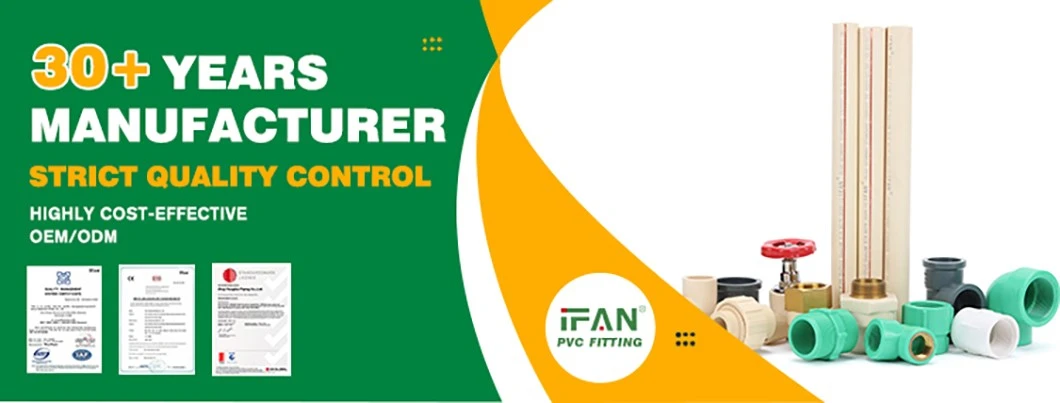
| Product Name | IFAN CPVC Pipe |
| Size | 1/2"-2" Or Customized |
| Color |
White,Beige Or Customized |
| Package | IFAN standard packaging |
| Sample | Sample Free |
| Contact | Click HERE to contact us now! |
Welcome to contact IFAN, we are online 24 hours a day to answer your questions!

Understanding the Maintenance Requirements of UPVC Pipes
Maintenance is an important part of managing any piping system, whether it is installed in a residential building, commercial property, agricultural facility, or industrial environment. Regular inspections and appropriate maintenance procedures help identify potential problems before they develop into more complicated issues. However, the amount of attention required varies depending on the pipe material, operating conditions, installation quality, and type of fluid being transported.
UPVC (unplasticized polyvinyl chloride) pipes are commonly used in water distribution, drainage, irrigation, and wastewater systems. Their maintenance requirements are generally straightforward because their non-metallic composition does not involve conventional rust formation or the corrosion-control procedures associated with certain metal pipes. Nevertheless, minimal maintenance does not mean that inspections can be completely ignored. Understanding the specific maintenance needs of UPVC piping helps property owners and facility managers establish practical inspection schedules.
No Routine Rust Removal or Repainting
One of the most noticeable differences between UPVC and traditional steel piping is the maintenance associated with surface oxidation. Metallic pipes exposed to moisture and oxygen may develop rust, depending on their material composition and environmental conditions. In some installations, this requires surface cleaning, protective coatings, or repainting at scheduled intervals.
UPVC does not undergo conventional iron-based rust formation because it is manufactured from a non-metallic polymer. Consequently, routine rust removal and corrosion-related repainting are not normally part of standard UPVC pipe maintenance.
However, external appearance should still be checked during inspections. Discoloration, unusual surface changes, scratches, or visible deformation may indicate exposure to unsuitable environmental conditions or mechanical damage. Any unusual changes should be evaluated according to the manufacturer's recommendations.
Simple Routine Visual Inspections
Routine visual inspection is one of the basic maintenance activities for UPVC piping systems. Unlike complicated mechanical equipment, many accessible pipe sections can be examined without specialized inspection procedures.
During an inspection, maintenance personnel should look for visible cracks, unusual bending, damaged fittings, loose supports, and signs of leakage. Particular attention should be given to connection points, valves, exposed pipe sections, and areas where the pipeline passes through walls or floors.
For residential installations, inspections can often be incorporated into ordinary plumbing checks. Commercial and industrial facilities may require more formal inspection records depending on the operating conditions and applicable safety requirements.
Underground pipelines require a different approach because their full length cannot normally be examined visually. Inspection chambers, accessible connections, and suitable testing methods can be used to assess their condition.
Limited Cleaning Requirements for Internal Surfaces
The internal condition of a pipe influences how easily water and other liquids move through the system. UPVC pipes generally have smooth internal surfaces, which provide a relatively uniform passage for fluid transportation.
In ordinary water supply applications, routine internal cleaning is not usually required solely because of the pipe material. However, deposits may still develop depending on water quality, operating conditions, and the substances transported through the pipeline.
Drainage systems have different cleaning requirements. Wastewater may contain grease, hair, food particles, soap residues, and other materials that can accumulate at bends or connection points. These substances may cause blockages even when the pipe interior is relatively smooth.
Where cleaning is necessary, suitable methods include approved drain-cleaning equipment and controlled flushing procedures. Chemical cleaning agents should only be used after checking their compatibility with UPVC pipes, fittings, and sealing components.
Attention to Pipe Connections and Joint Areas
Although UPVC pipe sections generally require limited routine maintenance, their connections deserve particular attention. Joints are important locations because they bring together separate pipe sections and may involve sealing materials or chemically bonded surfaces.
Solvent cement connections should be examined for visible leakage, cracks around the fitting, or signs of external stress. Rubber ring joints should be checked for movement, leakage, or damage where accessible.
If a connection develops a leak, the repair method depends on the joint type and the condition of the surrounding components. Some situations require replacement of the fitting or affected pipe section rather than applying an external sealant.
Maintenance personnel should avoid making temporary repairs that are inconsistent with the manufacturer's instructions. Correct replacement components and approved joining procedures should always be used.
Protecting UPVC Pipes from Physical Damage
Maintenance requirements are also influenced by the environment surrounding the pipeline. Although UPVC pipes are designed for specified operating conditions, excessive external forces can cause cracks, deformation, or other physical damage.
Aboveground installations should be checked for accidental impacts, unsuitable supports, and excessive loading from nearby objects. Pipe brackets should be positioned according to the recommended spacing to control movement and prevent unnecessary stress.
Underground UPVC pipes require appropriate soil support and backfill arrangements. If ground settlement or construction activities affect the surrounding area, the pipeline may experience additional mechanical loading.
Outdoor installations should also be evaluated for prolonged ultraviolet exposure. Where necessary, protective measures recommended by the manufacturer should be considered. These precautions help reduce the likelihood of environmental damage that could lead to additional maintenance work.
Monitoring Pressure and Operating Conditions
For pressurized UPVC systems, monitoring operating pressure is an important maintenance activity. Excessive pressure, sudden pressure changes, or repeated hydraulic shocks may place unnecessary stress on pipe sections and connections.
Pressure readings should be compared with the design specifications and the manufacturer's recommended operating limits. If unexpected pressure fluctuations occur, the cause should be investigated rather than assuming that the pipe material is responsible.
Temperature also requires consideration. UPVC pipes are designed for specific temperature ranges, and their pressure capacity may change as operating temperature increases. Systems transporting heated liquids should therefore be monitored according to the applicable technical specifications.
Maintaining suitable operating conditions helps avoid unnecessary repairs and makes it easier to identify abnormal changes during routine inspections.
Establishing a Practical Maintenance Schedule
A suitable maintenance schedule depends on the application and operating environment. A small residential cold-water installation generally has different inspection requirements from an industrial wastewater network or an agricultural irrigation system.
For residential systems, periodic checks of accessible joints, valves, and exposed pipe sections may be sufficient under normal conditions. Commercial facilities may need documented inspections that include pressure monitoring, leakage checks, and examination of important connection points.
Irrigation systems should be checked for blocked outlets, damaged fittings, and sediment accumulation. Drainage installations may require additional attention at inspection chambers and locations where waste materials are likely to collect.
Keeping simple maintenance records helps identify recurring problems and provides useful information when replacement or repair work becomes necessary.




Hot Tags: upvc pipe requires minimal maintenance effort, China upvc pipe requires minimal maintenance effort manufacturers, suppliers, factory, Plastic PVC Pipes, PVC Water Pipes
No Information


