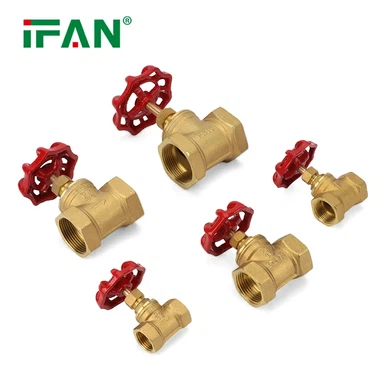


Brass Gate Valve Handles High Pressure
Type:Brass Gate Valve
Brand:IFAN
Connecting method:Thread
Applications:Water Systems
Color:Brass
- Fast Delievery
- Quality Assurance
- 24/7 Customer Service
Product Introduction

| Product Name | Brass Gate Valve |
| Color | Brass Color |
| Size | 1/2''-1'' |
| Brand | IFAN or Customized |
| OEM |
Support |
| Sample | Free |
| Experience | 30+Years |
| Contact Us | Click HERE to contact us now! |
Welcome to contact IFAN, we are online 24 hours a day to answer your questions!
Introduction
In pressurized piping systems, valves are required to manage internal forces generated by pumps, gravity-fed networks, and process-driven fluid movement. These forces act continuously on internal components, especially at connection and sealing points. A brass gate valve is commonly used in such systems because its internal structure is designed to control flow under elevated pressure conditions. Instead of relying on complex flow regulation mechanisms, it uses a direct mechanical gate movement that interacts with internal pressure in a controlled and stable manner. Understanding how it handles high pressure requires examining its internal force distribution and structural alignment.
Internal Pressure Distribution Across Valve Body
When fluid flows under high pressure through a pipeline, the force is distributed across all internal surfaces of the valve body. In a brass gate valve, the internal cavity is shaped to guide this pressure along a relatively uniform path. The flow passage does not include abrupt internal narrowing when the valve is fully open, which helps maintain consistent pressure distribution through the internal chamber.
This balanced distribution reduces localized stress concentration points within the valve body. Instead of pressure acting unevenly on isolated internal sections, the structure allows force to be spread across the internal geometry in a controlled manner. This is an important aspect of how the valve manages high-pressure flow conditions.
Gate Position Stability Under Pressure Load
The gate inside the valve plays a central role in controlling flow under pressure conditions. When the valve is open, the gate is fully retracted from the main flow path, minimizing direct exposure to fluid force. When closed, the gate is positioned directly against the seat, forming a barrier against pressurized fluid.
In both states, the gate maintains a defined and stable position within the valve body. This stability ensures that pressure does not cause irregular movement of the gate during operation. The guided vertical motion of the gate, controlled by the stem, helps maintain consistent positioning even when internal pressure levels increase.
Stem Mechanism and Pressure-Resistant Movement
The stem mechanism converts rotational motion into linear movement, allowing the gate to be raised or lowered within the valve body. Under high-pressure conditions, this mechanical system must maintain controlled movement without deviation from its intended path.
The threaded interface between the stem and valve body provides structured movement that resists internal pressure forces acting against the gate. As the stem rotates, the gate moves along a fixed axis, ensuring that pressure does not displace it laterally or disrupt its alignment. This controlled movement is essential when operating the valve in high-pressure environments.
Seat Interface Under Pressurized Conditions
The seat inside the valve provides the surface against which the gate closes when flow needs to be stopped. Under high-pressure conditions, the interaction between the gate and seat becomes a key structural point within the system.
When the valve is closed, pressure from the upstream side acts directly against the gate surface, which is held in position against the seat. The fixed seating structure ensures that the gate remains aligned with the sealing surface. This controlled interface helps define the boundary between pressurized and non-pressurized sections of the pipeline.
Flow Path Control in Pressurized State
When the valve is open, the internal flow path is designed to allow fluid to move through the body without abrupt directional changes. Even under high pressure, the internal passage maintains a direct connection between inlet and outlet sections.
This continuous flow channel allows pressure to pass through the valve in a predictable manner. The internal geometry avoids sudden constrictions that could cause localized pressure spikes. As a result, the flow remains aligned with the pipeline direction, even when operating under elevated pressure conditions.
Controlled Transition Between Pressure States
During operation, valves may transition between open and closed states while the system remains under pressure. These transitions must be managed in a way that avoids sudden internal disruptions.
The brass gate valve uses a gradual movement mechanism controlled by the stem, allowing the gate to move slowly into or out of the flow path. This controlled transition ensures that pressure changes occur in a predictable sequence rather than an abrupt shift. The internal movement system helps manage pressure variations during operation cycles.



Hot Tags: brass gate valve handles high pressure, China brass gate valve handles high pressure manufacturers, suppliers, factory, 2 Inch Brass Gate Valve, Brass Gate Valve, Brass Gate Valve 3 Inch, Brass Gate Valve Price, Brass Globe Valve, Gate Valve For Drinking Water