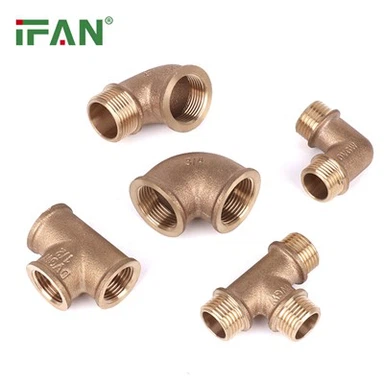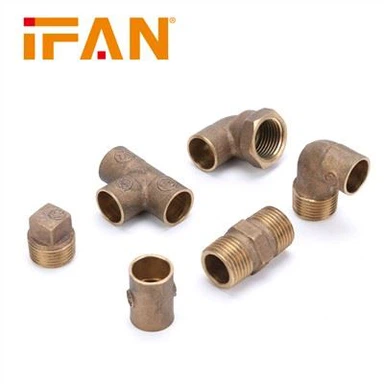


Bronze Threaded Fittings Ensure Reliable Connections
Type:Stainless steel pipe fittings
Brand:IFAN
Connecting method:Thread
Applications:Water Systems
Color:Sliver
- Fast Delievery
- Quality Assurance
- 24/7 Customer Service
Product Introduction


| Product Name | IFAN Bronze Threaded Fittings |
| Size | 1/2"-1" Or Customized |
| Color |
Yellow Or Customized |
| Package | IFAN standard packaging |
| Features | Durable |
| Sample | Sample Free |
| Contact | Click HERE to contact us now! |
Welcome to contact IFAN, we are online 24 hours a day to answer your questions!
A Secure Connection Starts With Proper Threading
Bronze threaded fittings are commonly used where pipes need to connect to valves, equipment, or other threaded components. Their connection depends on accurately formed male and female threads that engage with one another and create a controlled mechanical joint.
Unlike a connection that is permanently fused, a threaded joint can be assembled by turning the fitting onto the corresponding thread. This makes thread accuracy an important part of the connection. The fitting must have the correct thread size, type, and specification for the component being connected.
When these dimensions are matched correctly, the threads provide a defined path for assembly. The fitting can be positioned to the required orientation while maintaining contact between the corresponding thread surfaces. Reliable connections therefore begin with selecting compatible components rather than relying on excessive tightening to compensate for a mismatch.
Matching Thread Standards Correctly
Thread compatibility is one of the most important factors in creating a reliable bronze fitting connection. Different plumbing systems may use different thread standards, profiles, diameters, or pitches. Two components may appear visually similar while still being unsuitable for direct connection.
Before assembly, installers should verify the thread specifications of both components. The fitting should correspond to the pipe, valve, adapter, or equipment connection according to the project requirements.
Correct matching allows the threads to engage smoothly and maintain the intended mechanical relationship. If incompatible threads are forced together, the connection may be damaged or may fail to seal correctly. Careful identification before installation is therefore more effective than trying to correct a problem after assembly.
The Role of Thread Sealants
Threaded connections commonly require a suitable sealing method to control the passage of water through the helical space between mating threads. Depending on the application, this may involve an approved thread sealant or suitable sealing tape.
The sealing material should be compatible with bronze, the connected components, and the fluid being transported. It should also be appropriate for the system's temperature and pressure conditions.
Sealant should be applied according to the manufacturer's instructions. Too little may leave an inadequate sealing path, while excessive material can interfere with assembly or enter parts of the plumbing system where it is not wanted.
The thread itself provides the mechanical engagement, while the sealing material addresses the fluid-tight aspect of the joint. These two functions should be considered separately when evaluating the connection.
Controlled Tightening Matters
A threaded fitting should be tightened sufficiently to establish the intended connection without applying unnecessary mechanical force. Excessive tightening does not automatically create a more reliable joint.
Over-tightening can damage threads, deform components, or place unwanted stress on the fitting and connected pipe. On the other hand, insufficient tightening may leave the connection improperly seated or inadequately sealed.
The appropriate tightening method depends on the fitting type, thread specification, sealant, and manufacturer's instructions. Installers should use the recommended procedure rather than relying on feel alone, particularly when working with multiple connections in the same plumbing system.
Clean Threads Improve Assembly
Before bronze threaded fittings are assembled, the mating threads should be inspected and kept free from dirt, metal particles, old sealant, and other foreign material. Contamination can interfere with thread engagement and make it difficult to achieve consistent assembly.
The fitting and mating component should also be checked for damaged or deformed threads. A thread that has been crossed, crushed, or otherwise altered may not engage correctly even when the nominal dimensions appear correct.
Cleaning and inspection provide a simple opportunity to identify connection problems before the fitting is installed. This is especially useful in systems containing many threaded joints, where a small preparation issue can be repeated across multiple connection points.
Maintaining Alignment During Assembly
Alignment between the fitting and the connected component affects how the threads engage. The two parts should meet along their intended axis rather than being forced together at an angle.
Cross-threading is a common assembly problem that occurs when the threads fail to engage correctly at the beginning of installation. Once the fitting has started incorrectly, continued tightening can damage the thread profile.
A careful installer can reduce this risk by positioning the components correctly and beginning the connection without excessive force. If the fitting does not engage smoothly, it should be removed and inspected rather than forced into place.
Connecting Bronze With Other Materials
Bronze threaded fittings may be installed alongside components made from brass, copper, stainless steel, steel, or other materials. The connection between different metals requires consideration of the complete plumbing assembly.
The thread dimensions must first be compatible. Beyond that, the fluid environment and potential electrochemical interaction between dissimilar metals should be considered where applicable.
Approved transition components or isolation methods may be appropriate in certain installations. The selection depends on the water chemistry, material combination, operating conditions, and applicable plumbing requirements.
A reliable connection is therefore not determined solely by the bronze fitting. The connected materials and their interaction within the complete system also need to be evaluated.
Inspection After Assembly
After installation, each threaded connection should be inspected before the piping system is placed into normal service. The installer can check whether the fitting is correctly oriented, whether the connection appears properly assembled, and whether there are visible signs of thread damage or sealant problems.
Pressure testing should then be carried out according to the project specification and applicable plumbing requirements. Testing provides an opportunity to identify leakage while the connection remains accessible.
If a joint does not perform as expected during testing, it should be examined rather than simply tightened repeatedly. The issue may involve thread compatibility, sealant application, component damage, or incorrect assembly.
Reliable Connections Through Controlled Assembly
Bronze threaded fittings ensure reliable connections when the entire joining process is carefully controlled. Correct thread matching establishes mechanical compatibility, while appropriate sealant helps create the fluid-tight interface required for water service.
Clean threads, accurate alignment, controlled tightening, compatible materials, and proper inspection all contribute to the final connection. No single step should be treated as a substitute for the others.


Hot Tags: bronze threaded fittings ensure reliable connections, China bronze threaded fittings ensure reliable connections manufacturers, suppliers, factory, Bronze Fitting, Bronze Pipe Fitting, Bronze Plumbing Fitting