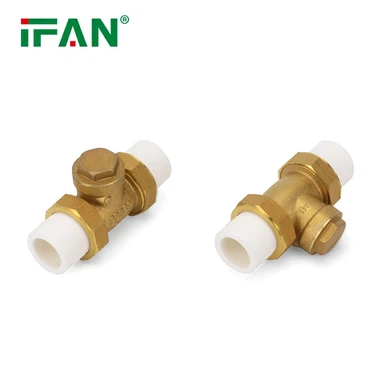


HDPE Butt Fusion Fittings Simplify Pipeline Installation
Brand: IFAN
Materials:PE
Size:63-400mm
Sample: Free Sample
Service: OEM&ODM
- Fast Delievery
- Quality Assurance
- 24/7 Customer Service
Product Introduction
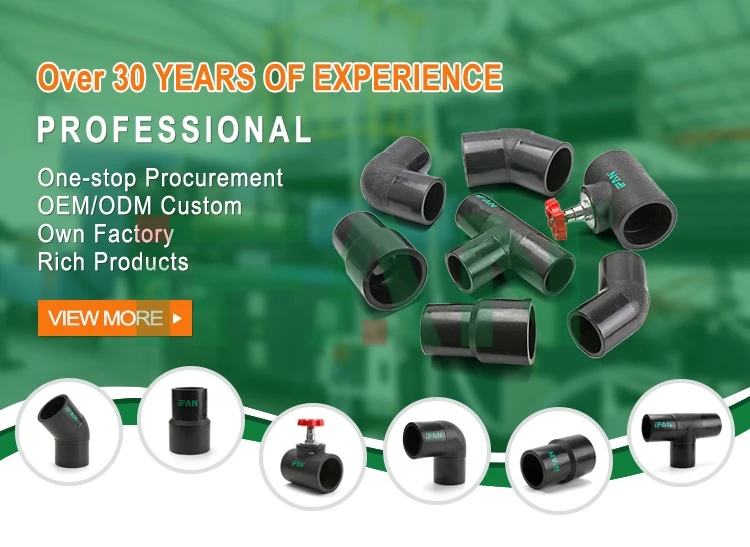
| Product Name | HDPE Butt Fusion Fittings |
| Size | 63-400mm |
| Color | Black Color Or Customized |
| Connection | Welding |
| MOQ | 100PCS |
| Sample | Sample Free |
| Contact |
Understanding the Butt Fusion Installation Method
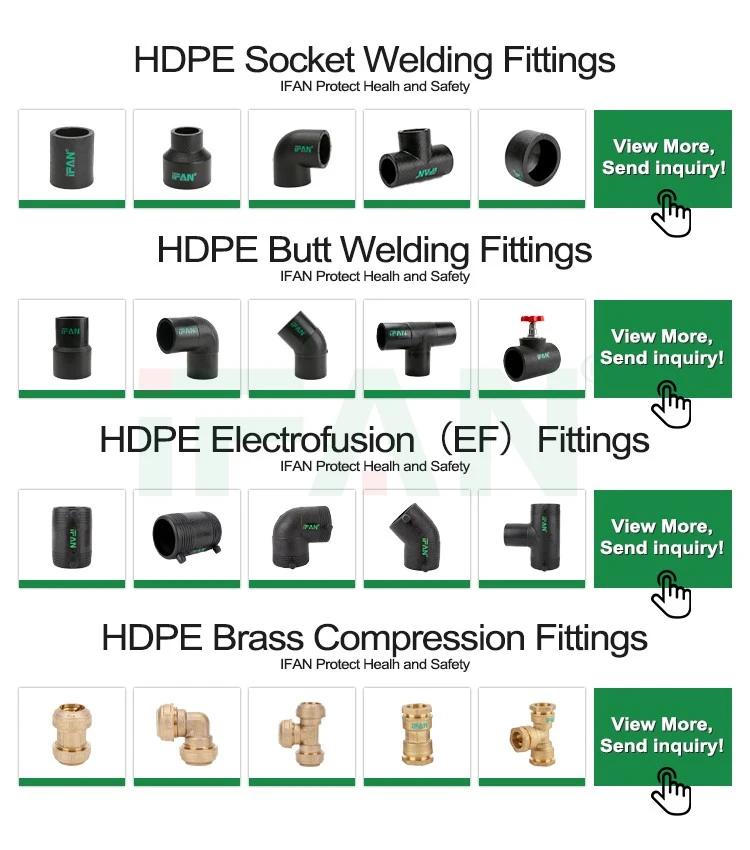
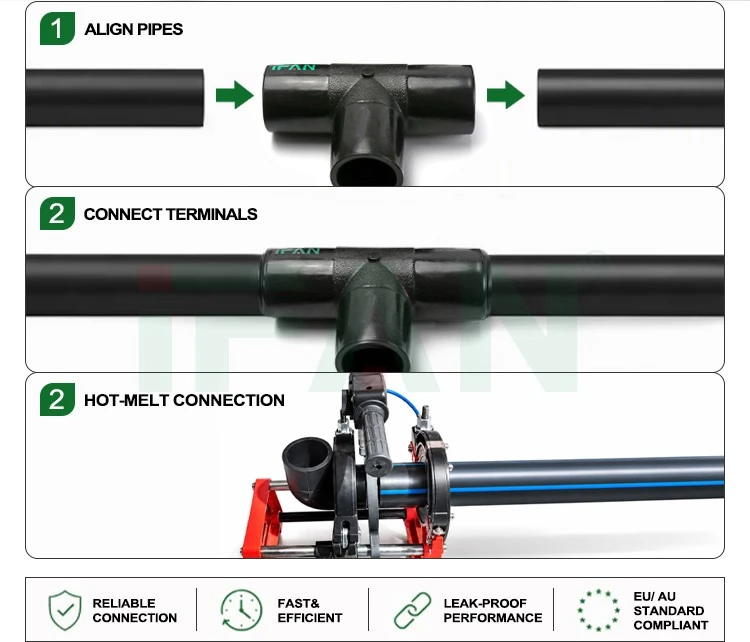
High-density polyethylene (HDPE) butt fusion fittings are designed to connect polyethylene pipes through a controlled heat-fusion process. This installation method involves preparing the pipe and fitting ends, heating their joining surfaces, and pressing them together under specified conditions. Once the fused interface has cooled, the components form a continuous connection that becomes part of the pipeline assembly.
Unlike HDPE socket welding fittings, which receive a heated pipe end inside a matching socket, butt fusion fittings are joined through the direct contact of prepared end surfaces. This difference influences equipment selection, joint preparation, alignment requirements, and the amount of working space needed at the installation site.
Butt fusion is commonly used for pipelines with compatible pipe and fitting dimensions, particularly where the system includes straight sections, bends, tees, reducers, and other purpose-designed components. Understanding the installation sequence before work begins helps contractors organize materials, prepare equipment, and coordinate each connection according to the applicable fusion procedure.
Preparing Pipes and Fittings Before Installation
A well-organized installation begins with checking the pipe and fitting specifications. Installers should confirm the outside diameter, wall thickness, material compatibility, pressure classification, and fitting configuration before moving components into the fusion area. These checks help prevent interruptions caused by mismatched parts or incorrect dimensions.
The pipe ends must then be cut squarely and prepared according to the manufacturer's instructions. A suitable facing tool removes surface irregularities and creates parallel ends for joining. Clean preparation is essential because uneven surfaces can interfere with uniform contact during fusion.
After preparation, the components should be protected from dust, moisture, grease, and accidental handling. Installers should also arrange the pipes so that their ends can enter the fusion machine without excessive movement. Taking time to prepare the work area reduces repeated adjustments during the joining sequence and allows the installation team to follow a consistent procedure from one connection to the next.
Organizing Equipment and the Working Area
Butt fusion installation generally requires a fusion machine, clamping equipment, a facing tool, a heating plate, and suitable handling equipment for the pipe dimensions involved. The machine holds the components in alignment while the joining surfaces are prepared, heated, and brought together. Equipment capacity should match the pipe size and the manufacturer's specified installation requirements.
Before work begins, the operator should inspect the machine, confirm that the heating plate has reached the required temperature, and verify the operation of relevant controls. The working area should provide enough space to position the pipe sections, move the heating plate, and operate the machine safely.
Long pipe sections may require rollers or other supports to prevent their weight from placing unnecessary stress on the connection during alignment. On construction sites, the layout should also account for trenches, nearby structures, and restricted access. Proper equipment placement helps maintain an orderly workflow and reduces the need to reposition heavy components repeatedly.
Aligning Pipe Ends and Fittings
Accurate alignment is a central part of butt fusion installation. The pipe and fitting are secured in the machine clamps, and their ends are brought into position for facing and inspection. The operator checks that the joining surfaces are parallel and that the components share the required centerline.
Following a Controlled Heating and Joining Sequence
Once alignment and surface preparation are complete, the operator follows the specified fusion procedure. The prepared ends are brought into contact with the heating plate, which transfers heat to the polyethylene surfaces. Heating time and conditions depend on the pipe dimensions, material specifications, equipment, and approved procedure.
After the required heating stage, the plate is removed, and the softened ends are brought together within the prescribed transition time. The machine then applies the specified joining force to establish contact between the molten surfaces. The operator must avoid unnecessary delays or uncontrolled movement because these can affect the quality of the fusion interface.
Butt fusion installation is therefore a sequence of coordinated operations rather than a simple heating task. Each stage must be completed in the correct order, with process parameters controlled according to the relevant instructions. Following a defined procedure also helps different installation teams maintain consistency across a large pipeline project.
Installing Fittings Within Complex Pipeline Layouts
HDPE butt fusion fittings can be incorporated into pipeline layouts containing changes in direction, branch connections, and transitions between pipe sizes. Before installation, contractors should review the drawings and determine the sequence in which each fitting will be joined. This planning is particularly important when several connections must be completed within a confined work area.
Bends, tees, and reducers should be positioned with their orientation confirmed before fusion begins. Incorrect positioning may require unnecessary rework or make it difficult to connect the next pipe section. Temporary supports and suitable handling equipment can help maintain the intended layout while the components are aligned and joined.
Where trench installation is involved, contractors should determine which joints can be assembled above ground and which must be completed in place. The chosen sequence should account for equipment access, lifting requirements, pipe movement, and inspection needs. A practical installation plan allows individual connections to be completed without creating avoidable obstacles for subsequent work.
Inspection and Installation Documentation
After installation, each connection should be checked against the project's inspection requirements. Visual examination can identify irregular bead formation, obvious contamination, excessive misalignment, or other visible concerns. Any suspected defect should be assessed according to the applicable standard and the manufacturer's recommendations.
Where required, fusion parameters, operator identification, equipment details, and joint inspection results should be recorded. These records help project teams track installation progress, investigate inconsistencies, and verify that the prescribed joining procedure was followed. The completed pipeline must also undergo the specified testing before being accepted for service.



Hot Tags: hdpe butt fusion fittings simplify pipeline installation, China hdpe butt fusion fittings simplify pipeline installation manufacturers, suppliers, factory, Compression HDPE Pipe Fittings, HDPE Pipe and Fitting, HDPE Pipe Socket, HDPE Water Pipe Fittings, PE Pipe, PE Pipe Fitting