
Consistent Joint Performance From PEX Slide Fittings
Oct 29, 2026

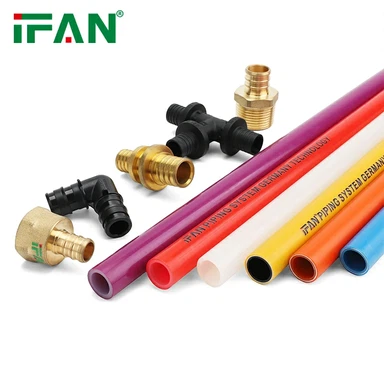
| Product Name | PEX Slide Fittings |
| Size | 16-32mm |
| Color | Brass Color Or Customized |
| Connection | Sliding |
| MOQ | 200PCS |
| Sample | Sample Free |
| Contact | Click HERE to contact us now! |
Welcome to contact IFAN, we are online 24 hours a day to answer your questions!
Introduction: The Value of Uniform Plumbing Connections
A plumbing system contains many individual connections, and each one must perform reliably under the conditions for which it was designed. When a building has dozens or hundreds of joints, consistency becomes especially important. Differences in installation quality can lead to uneven performance, unexpected leaks, and additional maintenance work. PEX slide fittings offer a mechanical connection method for compatible cross-linked polyethylene tubing, helping plumbing professionals establish uniform joints through a defined assembly process.
Consistent performance does not happen automatically because a particular fitting is used. It comes from combining suitable materials, accurate preparation, correct tooling, and careful workmanship. When these elements are managed properly, installers can reduce variations between connections and improve confidence in the completed plumbing system. Understanding the factors that influence joint performance helps contractors maintain quality across projects of different sizes and complexity.
1. Standardized Assembly Promotes Consistency
One of the main advantages of a defined joining procedure is that it gives installers a repeatable method to follow. PEX slide fittings use compatible sleeves and fittings to secure tubing through a mechanical connection. Each joint must be assembled according to the instructions provided for the specific product.
A standardized procedure reduces uncertainty during installation. Workers can follow the same preparation and assembly sequence rather than relying on personal habits or improvised techniques. This is particularly valuable on projects where several installers are responsible for different sections of the same water distribution system.
Contractors can strengthen this consistency by providing clear instructions, checking tools before work begins, and training workers on the selected fitting system. When everyone follows the same approved method, differences in workmanship become easier to identify and correct.
2. Component Compatibility Protects Joint Integrity
Even a carefully assembled joint may not perform as intended if its components are incompatible. PEX tubing, sleeves, and fittings are manufactured to specific dimensions and performance requirements. Similar-looking products are not necessarily interchangeable.
Before installation, plumbers should verify that every component is approved for use with the others. The selected fitting must also be suitable for the intended application, including its expected operating pressure and temperature. This is particularly important when a project includes different tubing types or specialized hot-water systems.
Using the specified components helps maintain the mechanical relationship between the tubing, fitting, and sleeve. It also makes future maintenance more straightforward because replacement parts can be selected according to the original system requirements. Careful material selection is therefore an essential part of achieving consistent results across an entire installation.
3. Accurate Preparation Reduces Variations Between Joints
Small preparation differences can affect the quality of finished connections. An uneven cut, damaged tubing end, or incorrectly positioned sleeve may prevent a joint from being assembled as intended.
Installers should examine each section of tubing before making a connection. Cuts must be clean and square, and any tubing with unacceptable damage should be addressed before assembly. The fitting should be inserted and the sleeve positioned according to the manufacturer's specified procedure.
Although these steps may appear routine, repeating them correctly is fundamental to consistent workmanship. Skipping preparation checks to save a few seconds can introduce defects that take much longer to investigate later.
A disciplined approach allows installers to maintain similar standards across every connection, regardless of whether the joint is located in an accessible utility room or a more demanding installation area.
4. Managing Environmental and Operating Conditions
Joint performance depends partly on the conditions surrounding the plumbing system. Changes in water temperature, pressure fluctuations, physical movement, and exposure to unsuitable environments can affect the complete installation.
PEX slide fittings must operate within their approved limits. Plumbers should consider expected water pressure, temperature requirements, and the conditions in which the tubing will be installed. Proper pipe support and protection at wall or floor penetrations can help prevent unnecessary stress from reaching connection points.
Freezing temperatures, excessive heat, and physical damage should also be addressed through appropriate design and protective measures. Even a correctly assembled fitting cannot compensate for a system that operates outside its intended conditions.
Considering these factors during planning helps ensure that consistent installation quality translates into dependable performance during normal operation.
5. Inspection and Testing Establish Confidence
A uniform assembly process should be supported by an effective quality-control plan. Before connections are concealed, installers should check accessible joints for correct assembly and visible damage.
The completed plumbing system must then be inspected and tested according to the manufacturer's requirements and applicable local plumbing codes. Testing can help identify defects that may not be apparent during a visual examination. Any failed connection should be corrected using an approved procedure before the system is placed into service.
Maintaining installation records can provide additional value. Details about the fitting system, tubing dimensions, and inspection results help supervisors track workmanship and support future repairs. Over time, these records can also reveal recurring problems that require changes to training or installation procedures.