
HDPE Electrofusion Fitting For Space-Saving Pipe Connections
Oct 27, 2026

| Product Name | HDPE Electrofusion Fitting |
| Size | 50-630mm |
| Color | Black Color Or Customized |
| Connection | Electrofusion |
| MOQ | 100PCS |
| Sample | Sample Free |
| Contact |
Meeting the Challenges of Limited Installation Space
Modern piping systems are often installed in locations where available space is restricted. Underground utility corridors, plant rooms, narrow service trenches, equipment enclosures, and building renovation projects may leave little room for conventional joining tools or complicated pipe arrangements. In these environments, the dimensions of the connection and the space required to assemble it can influence the entire installation plan.
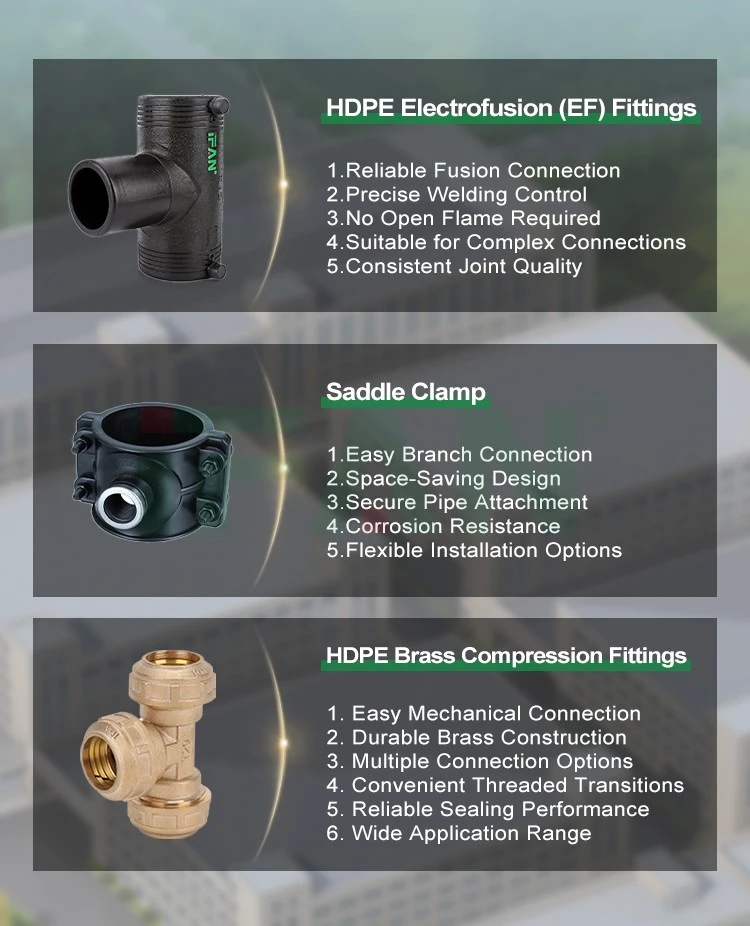
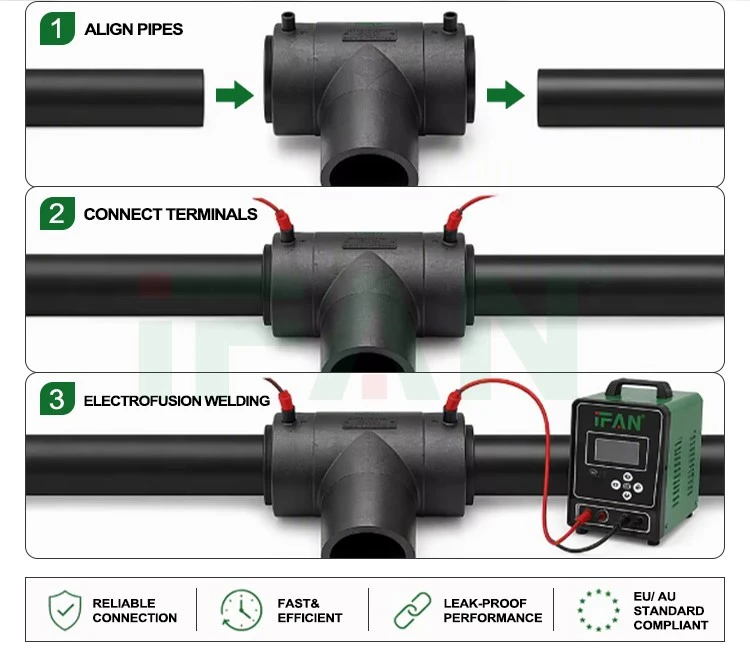
HDPE electrofusion fittings offer a practical joining solution for compatible high-density polyethylene pipes. Each fitting incorporates an electrical heating element that generates heat at the joining interface, allowing the pipe and fitting surfaces to fuse together under controlled conditions. Because the connection is formed around the pipe, installers can often complete the joining process without positioning large butt fusion equipment directly around the joint.
The space-saving potential comes from the fitting configuration, the compact nature of the fusion equipment, and the ability to connect pipes in locations where access is limited. However, the actual clearance required depends on the fitting dimensions, cable connections, preparation tools, clamping arrangements, and installation instructions. Careful planning ensures that a compact connection does not come at the expense of joint quality.
Compact Fitting Designs for Flexible Pipe Layouts
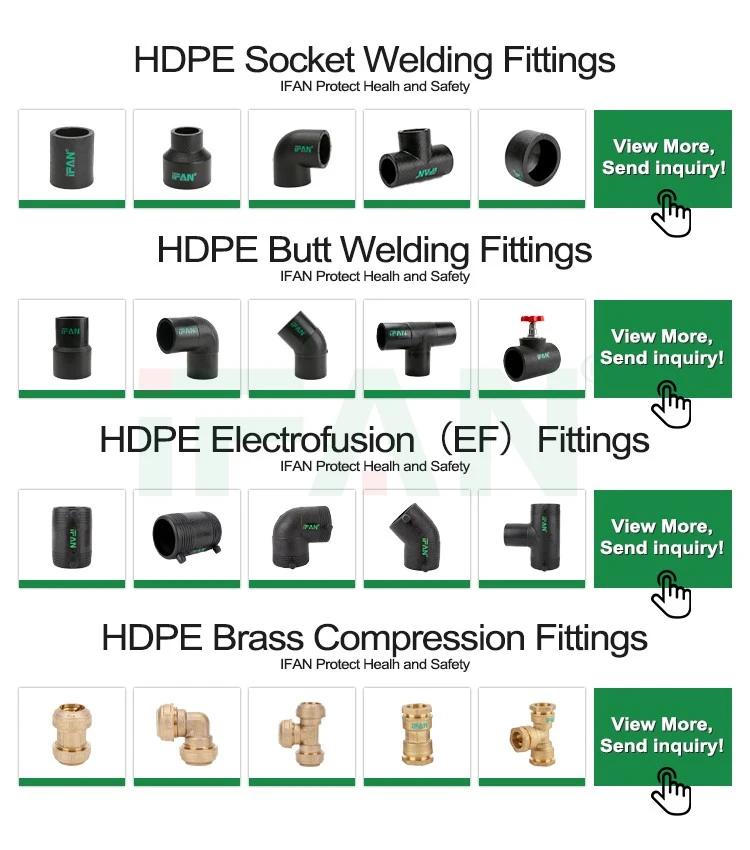
An efficient pipeline layout depends on choosing fittings that match the route, available clearance, and required connection points. HDPE electrofusion fittings are available in several configurations, including couplers, elbows, tees, reducers, and specialized branch fittings. Each type serves a different purpose when assembling a distribution or industrial piping network.
Couplers connect compatible pipe ends with a relatively straightforward external profile. Elbows allow the pipeline to change direction, while tees create branches for additional supply lines. Reducers connect pipes of different specified diameters where the design permits such a transition.
These fittings allow engineers to organize connections without introducing unnecessary sections of pipe or complicated arrangements of mechanical hardware. In a confined installation, selecting an appropriately shaped fitting may help avoid excessive offsets and reduce interference with nearby structures.
Nevertheless, a compact fitting does not eliminate the need for adequate installation clearance. Workers must still access the fusion zone, prepare the pipe surface, connect the control unit, and secure the assembly. The best layout balances physical space requirements with accessibility for installation, inspection, and future maintenance.
Simplifying Connections in Narrow Trenches
Underground piping projects frequently involve trenches with restricted width, particularly in established urban areas where water lines, electrical conduits, drainage pipes, and communication cables share limited space. Conventional joining equipment may be difficult to position when the pipeline lies close to a trench wall or another utility.
Electrofusion can provide greater flexibility in these conditions because the fitting is installed around the prepared pipe ends and heated using a compatible control unit. The equipment arrangement may be easier to manage than a process requiring larger machinery to grip and align both pipe sections, although the exact space requirements depend on the joint and tools used.
Before installation, contractors should confirm trench dimensions, pipe alignment, fitting orientation, and the working clearance needed for surface preparation. The pipeline should be positioned so that installers can complete each step without placing tools at unsafe angles or disturbing adjacent infrastructure.
Where several utilities occupy the same corridor, the fitting's external dimensions should also be considered during design. Proper coordination helps prevent clashes between pipes and supports and allows the completed connection to fit within the approved underground layout.
Improving Pipe Routing Around Existing Equipment
Industrial facilities often require new pipelines to connect with existing pumps, tanks, filtration units, heat exchangers, and processing equipment. The available space may already be occupied by structural supports, cable trays, valves, and other services. Adding a new pipe without careful planning can result in complicated routing and difficult installation access.
HDPE electrofusion fittings allow designers to create defined changes in direction and branch connections while maintaining compatibility with the selected polyethylene pipe system. A suitable elbow or tee can help the pipeline follow the required route without relying on improvised bends or unnecessary connection assemblies.
The fitting arrangement should be established using accurate measurements and coordinated drawings. Engineers must account for the fitting's overall dimensions, insertion depth, pipe movement, and the space required to complete the fusion process. Where equipment requires periodic servicing, the pipeline should not obstruct access panels, removable components, or operating controls.
Space-efficient routing should also consider hydraulic performance. Too many directional changes or poorly selected pipe dimensions can increase flow resistance. A compact design must therefore satisfy both the physical constraints of the installation and the operating requirements of the system.
Reducing the Need for Complicated Mechanical Assemblies
Some piping arrangements use multiple mechanical components to accommodate changes in direction, diameter, or connection type. Depending on the design, these assemblies may require additional clearance for fasteners, tightening tools, or separate sealing components.
An HDPE electrofusion fitting combines the joining function within a purpose-designed component. Once the compatible pipe and fitting have been correctly fused, the connection does not depend on a conventional threaded joint or a separately compressed gasket at the fusion interface. This can simplify the physical arrangement around selected pipe connections.
The number and type of fittings should still be determined by the pipeline design rather than by a desire to minimize component count alone. Isolation valves, dismantling provisions, transition fittings, and other equipment may remain necessary for safe operation and maintenance.
Engineers should evaluate each connection individually, considering installation space, pressure requirements, fluid compatibility, and the possibility of future modifications. Selecting a suitable electrofusion configuration can help create a more organized piping arrangement while preserving the functions required by the complete system.
Installation Planning in Restricted Working Areas
Space-saving connections are most effective when the installation sequence is planned before work begins. Contractors should identify locations where pipe movement is restricted and determine whether the fusion equipment, scraping tools, clamps, and electrical leads can be used safely.
Pipe ends must be prepared according to the manufacturer's requirements. The specified surface layer should be removed, the insertion depth marked, and the fitting positioned correctly. The assembly must remain stable during the heating cycle and throughout the required cooling period.
In particularly narrow spaces, workers may need to prepare pipe sections before lowering them into a trench or positioning them near existing equipment. Such arrangements are acceptable only when the approved procedure allows them and when the completed joint can be installed without excessive bending or external loading.
A practical installation plan should include inspection access and a clear sequence for handling completed joints. Adequate space for the work process remains essential even when the finished connection occupies relatively little room.
Maintaining Joint Quality Within a Compact Layout
A space-efficient pipeline must still meet all applicable quality requirements. Restricted access can make it harder to inspect preparation surfaces or keep the fitting aligned, so these issues should be addressed during the design stage.
Installers should verify material compatibility, fitting identification, pipe dimensions, and fusion settings before starting. Any error reported by the control unit must be handled according to the manufacturer's instructions. The joint should not be disturbed before the specified cooling period has elapsed.
After installation, connections should undergo the inspections and testing required by the project specifications. Documentation should record fitting locations and relevant fusion information, especially in buried or difficult-to-access systems.
Planning for quality from the beginning prevents the space-saving objective from creating avoidable installation problems. A well-designed connection must fit its surroundings while remaining accessible enough to install and verify correctly.