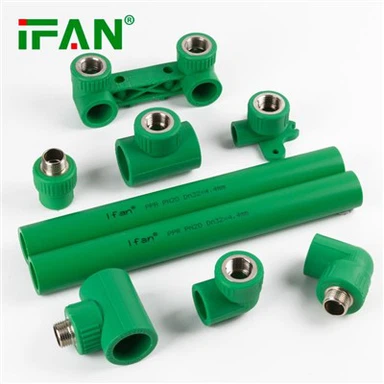

PPR Fittings Offer Excellent Corrosion Resistance
Nov 19, 2026

| Product Name | PPR Pipe Fittings |
| Size | 20-63mm Or Customized |
| Color |
Green,White,Blue Or Customized |
| Package | IFAN standard packaging |
| Connection | welding |
| Sample | Sample Free |
| Contact |
Welcome to contact IFAN, we are online 24 hours a day to answer your questions!
Understanding the Corrosion Resistance of PPR Materials
Corrosion is an important consideration when selecting materials for water transportation and plumbing systems. Metal components may gradually react with water, dissolved oxygen, minerals, or certain chemicals, resulting in surface deterioration and the formation of corrosion products. Depending on the operating environment, these reactions can affect the internal condition of pipelines and the quality of transported water.
PPR fittings are manufactured from polypropylene random copolymer, a thermoplastic material with a nonmetallic molecular structure. Unlike iron-based fittings, PPR components do not undergo conventional electrochemical rusting when exposed to ordinary water and oxygen. This characteristic makes them suitable for many residential, commercial, and industrial water distribution applications.
Their corrosion resistance is related to the chemical characteristics of the polymer itself. However, actual material compatibility depends on the transported medium, chemical concentration, temperature, and exposure duration. Understanding these conditions is essential when evaluating PPR fittings for specific pipeline environments.
Nonmetallic Structure Prevents Conventional Rust Formation
One of the main distinctions between PPR fittings and traditional metal fittings is their response to water exposure. Iron and steel can undergo oxidation when moisture and oxygen are present. Over time, this process may produce rust that changes the surface condition of the material.
PPR fittings do not contain an iron-based structural body, so they do not generate conventional iron oxide through ordinary water contact. Their polymer composition avoids the electrochemical corrosion mechanism associated with many metallic plumbing components.
This characteristic is particularly relevant in water distribution systems where metal corrosion is a concern. The absence of conventional rust formation also means that the fitting material itself does not introduce iron corrosion particles into the water through this mechanism.
Nevertheless, water quality can still be influenced by other components in the pipeline. Pumps, storage tanks, metal adapters, and upstream equipment should also be considered when evaluating the corrosion characteristics of a complete water supply system.
Resistance to Common Water Chemistry
Water composition differs between geographical locations and supply systems. Municipal water may contain dissolved minerals, disinfectants, and other treatment substances, while industrial water may have a more complicated chemical profile.
PPR generally demonstrates compatibility with many common aqueous environments. Its polymer structure does not respond to water in the same way as conventional reactive metals, making it suitable for numerous ordinary water transportation applications.
However, corrosion resistance should not be confused with universal chemical resistance. Strong oxidizing agents, concentrated acids, certain solvents, and other aggressive substances may affect polypropylene under particular conditions.
Before selecting PPR fittings for specialized applications, engineers should examine the chemical composition of the transported medium. Manufacturer compatibility charts should be consulted to verify whether the selected material is appropriate for the concentration, temperature, and exposure period involved.
Stable Internal Surfaces and Corrosion-Related Deposits
The internal condition of a pipeline can influence water movement and maintenance requirements. In some metallic systems, corrosion products may gradually accumulate along internal surfaces. These deposits can change the effective passage area and contribute to local flow restrictions.
Because PPR fittings do not develop conventional iron rust, they avoid this particular source of internal corrosion deposits. Their smooth polymer surfaces also provide a suitable contact environment for many standard water distribution applications.
However, this does not mean that mineral scaling or sediment accumulation cannot occur. Water containing high concentrations of calcium, magnesium, or suspended particles may still produce deposits inside polymer pipelines and fittings.
Water quality management therefore remains important. Where necessary, filtration or water treatment should be considered according to the characteristics of the supply.
Chemical Compatibility in Hot Water Applications
Hot water systems require additional attention when evaluating the corrosion resistance of PPR fittings. Elevated temperatures can change the mechanical properties of polypropylene and may influence its response to certain chemicals.
For example, the compatibility of a fitting with a disinfectant or cleaning chemical at room temperature does not automatically establish suitability under continuous hot water exposure.
Engineers should evaluate both chemical concentration and operating temperature. The manufacturer's technical documentation can provide information about the permitted conditions for different substances.
Pressure must also be considered because the allowable working pressure of PPR generally decreases as operating temperature rises. A suitable product must satisfy both the chemical compatibility requirements and the pressure-temperature limitations of the intended application.
Corrosion Resistance at Pipeline Connections
Connections are important areas in any plumbing system because they join separate pipeline sections and may contain components made from different materials.
PPR fittings are commonly connected to compatible PPR pipes through socket heat fusion. This process joins the softened polymer surfaces and creates an integrated thermoplastic connection.
Unlike conventional threaded metal joints, the fused interface does not introduce an exposed metal sealing surface. This is relevant when designing pipeline sections intended to avoid conventional metallic corrosion.
However, some PPR fittings include metal threaded inserts for connection to pumps, valves, meters, or other equipment. These inserts must be selected according to the water chemistry and surrounding operating conditions. Their presence means that the corrosion resistance of the complete connection should be evaluated rather than considering only the polymer body.
Manufacturing Quality and Material Consistency
The corrosion resistance of a PPR fitting depends partly on the quality and consistency of its raw material. Manufacturers must use appropriate polymer grades and control the formulation of additives, pigments, and other processing ingredients.
Poor material selection or uncontrolled manufacturing conditions may affect the finished product's chemical characteristics. For this reason, quality control should include raw material verification, production monitoring, dimensional inspection, and relevant product testing.
The finished fitting should comply with the standards required for its intended application. For drinking water systems, relevant sanitary approvals and material migration requirements should also be checked.
Purchasers should request technical documentation that identifies the product material, application range, and applicable certifications. These details provide a more reliable basis for evaluating chemical suitability than general product descriptions.
Environmental Factors Affecting Material Resistance
Although PPR fittings resist conventional water-related corrosion, external environmental conditions can influence their material condition.
Prolonged ultraviolet exposure may cause degradation of polypropylene surfaces. Therefore, fittings installed outdoors or in areas exposed to direct sunlight may require appropriate protection or products specifically designed for those conditions.
Certain chemicals used in construction, maintenance, or industrial cleaning may also come into contact with external fitting surfaces. Compatibility should be checked before these substances are applied.
Proper storage is equally important. Fittings should be kept away from unsuitable chemicals, excessive heat, and prolonged direct sunlight before installation.
Inspection and Maintenance Considerations
Regular inspection helps confirm that PPR fittings remain suitable for their operating environment. Maintenance personnel should examine accessible components for surface damage, deformation, leakage, and changes around connections.
If discoloration, cracking, or unusual surface changes appear, the cause should be investigated. Such conditions should not automatically be attributed to corrosion, since ultraviolet exposure, chemical contact, overheating, and mechanical damage may produce similar symptoms.
The surrounding pipeline should also be checked for incompatible metal components or deposits originating elsewhere in the system.