

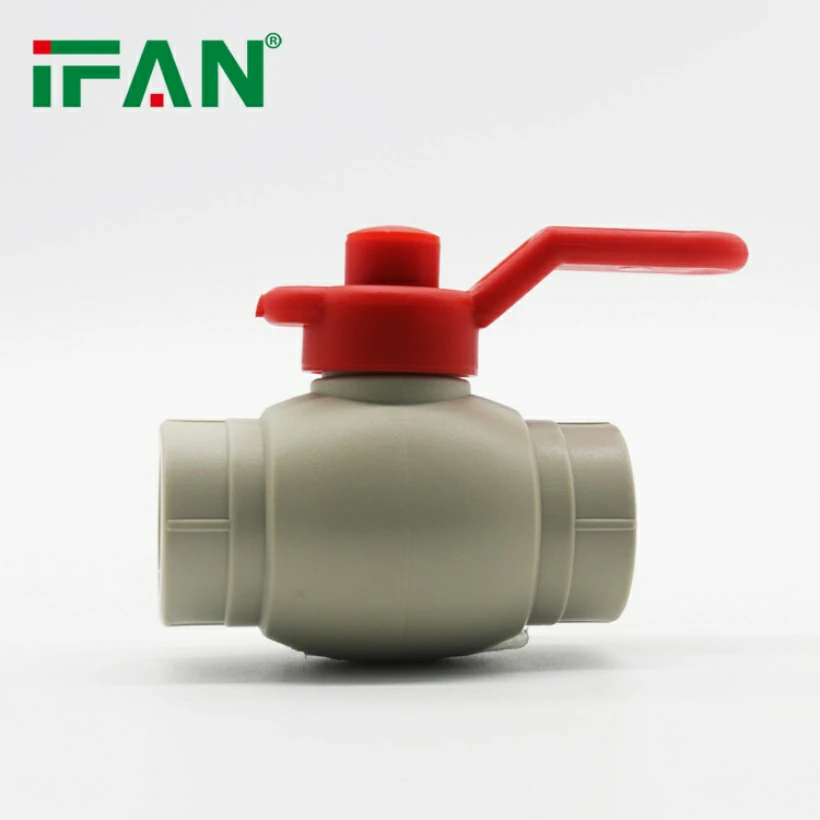
Easy Installation PPR Ball Valve
Type:PPR Ball Valve
Brand:IFAN
Connecting method:Hot Melt
Applications:Water Systems
Color:Green,White,Blue
- Fast Delievery
- Quality Assurance
- 24/7 Customer Service
Product Introduction

| Product Name | PPR Ball Valve |
| Size | 20-63mm Or Customized |
| Color |
Green,White,Blue Or Customized |
| Package | IFAN standard packaging |
| Connection | welding |
| Sample | Sample Free |
| Contact |
Welcome to contact IFAN, we are online 24 hours a day to answer your questions!
Introduction to PPR Ball Valve Installation
Installing valves in a piping system involves more than simply connecting two pipe sections. The installer must consider pipe dimensions, connection methods, alignment, installation space, and the sequence of assembly. When these details are not properly coordinated, the installation process may become complicated and require additional adjustments. A PPR ball valve is designed to integrate with polypropylene random copolymer piping through a compatible connection structure, making it relatively straightforward to incorporate into different pipeline layouts.
PPR ball valves are commonly used in residential water supply, commercial plumbing, and various building service systems. Their installation generally follows the same basic principles as PPR pipe connections. By combining a recognizable valve structure with a thermoplastic fusion connection, the valve can be incorporated into the pipeline without requiring complicated threaded or welded metal connections.
Understanding the installation process, from preparation to final inspection, helps installers complete each stage in an organized and technically correct manner.
Compatible Connection Design
One important factor affecting installation is the connection structure between the valve and the pipeline. PPR ball valves are commonly manufactured with socket-type ends designed for connection to PPR pipes of corresponding dimensions. This arrangement allows the valve to be integrated into the piping system using the same heat-fusion method applied to standard PPR fittings.
Before installation, the pipe diameter and valve connection specifications should be checked carefully. Both components must have compatible dimensions to establish the correct insertion depth and fusion conditions. Selecting the appropriate valve size also helps avoid unnecessary reducers, adapters, or additional connection components.
The socket connection provides a relatively direct assembly process. After the pipe and valve ends have been prepared, the corresponding surfaces are heated using a suitable fusion tool and joined according to the manufacturer's instructions. This creates a continuous thermoplastic connection without requiring conventional threaded joints at the PPR interface.
Preparation Before Installation
Proper preparation is an essential part of simplifying pipeline installation. Before starting the work, installers should review the pipeline drawings and identify the exact location where the PPR ball valve will be positioned. This helps determine the required pipe length, connection direction, and available operating space.
The necessary tools and materials should also be prepared in advance. Typical installation equipment includes a PPR fusion welding machine, suitable heating dies, a pipe cutter, measuring tools, and cleaning materials. The selected heating dies must match the pipe and valve connection dimensions.
The pipe ends should be inspected to ensure that they are clean, dry, and free from visible damage. Any burrs or uneven edges should be addressed before fusion. The valve should also be checked for contamination and dimensional defects.
Preparing these details before assembly reduces interruptions during installation and helps maintain a consistent workflow.
Heat Fusion Connection Process
Heat fusion is one of the main installation methods used for PPR ball valves. The process involves heating the external surface of the pipe and the internal surface of the valve socket until the thermoplastic material reaches the specified fusion condition.
First, the pipe should be cut perpendicular to its centerline. A straight cut helps ensure uniform contact between the connecting surfaces. The insertion depth can then be measured and marked on the pipe to provide a clear reference during assembly.
Next, the pipe and valve socket are placed onto the corresponding heating dies. Heating time and temperature must follow the specifications provided by the manufacturer, as different pipe dimensions require different processing conditions.
Once heating is complete, both components should be removed from the tool and joined immediately. The pipe should be inserted straight into the valve socket without unnecessary rotation. The connection must remain correctly aligned while the material cools. Excessive insertion force or incorrect positioning may cause deformation inside the flow passage.
Positioning and Pipeline Alignment
The position of a PPR ball valve should be determined before the surrounding pipeline is permanently connected. Unlike ordinary straight pipe fittings, a ball valve includes a handle that must remain accessible for operation. Therefore, installation planning should account for both the connection dimensions and the space required to rotate the handle.
The valve should be positioned so that its operating handle can move through the required quarter-turn range without interference from nearby pipes, walls, brackets, or equipment. In concealed pipeline installations, the location should also allow appropriate access for inspection and operation.
Pipe alignment requires similar attention. The connected pipes should approach the valve without creating excessive bending forces or unnecessary mechanical stress. Suitable pipe supports should be arranged to maintain the intended pipeline route and prevent the valve from carrying unsupported pipe loads.
Checking alignment before completing the fusion connections helps avoid complicated corrections after assembly.
Installation in Different Pipeline Layouts
PPR ball valves can be incorporated into various pipeline arrangements, including straight distribution lines, branch connections, and equipment supply pipelines. Their placement depends on the intended isolation point and the overall design of the water distribution system.
In a straight pipeline, the valve is generally installed between two pipe sections. The installer should determine the valve position and confirm that sufficient pipe length is available on both sides for the fusion connections.
For branch pipelines, the valve may be installed downstream of a suitable PPR tee fitting. The connection sequence should be planned to avoid situations where the fusion tool cannot reach the required joint.
In confined installation areas, the order of assembly becomes particularly important. Installers should identify which connections need to be completed first and ensure that the heating equipment can be positioned correctly. This approach helps prevent access difficulties during the fusion process.
Inspection and Installation Quality Control
After completing the connections, the installation should be inspected before the pipeline is placed into normal service. The first step is to examine the fusion joints for visible defects, including uneven connection edges, excessive material displacement, or signs of incomplete fusion.
The valve handle should then be operated to confirm that it can move through its intended range without obstruction. The surrounding installation should also be checked to ensure that the handle does not contact nearby components.
A pressure test should be conducted according to the applicable piping standards and project requirements. During testing, installers should examine the valve connections and surrounding pipe sections for leakage. The valve should also be checked in the appropriate open and closed positions as specified by the testing procedure.
Any identified installation problems should be corrected before the pipeline is put into operation.


Hot Tags: easy installation ppr ball valve, China easy installation ppr ball valve manufacturers, suppliers, factory