HDPE Butt Fusion Fittings Reduce Maintenance Costs
Brand: IFAN
Materials:PE
Size:63-400mm
Sample: Free Sample
Service: OEM&ODM
- Fast Delievery
- Quality Assurance
- 24/7 Customer Service
Product Introduction
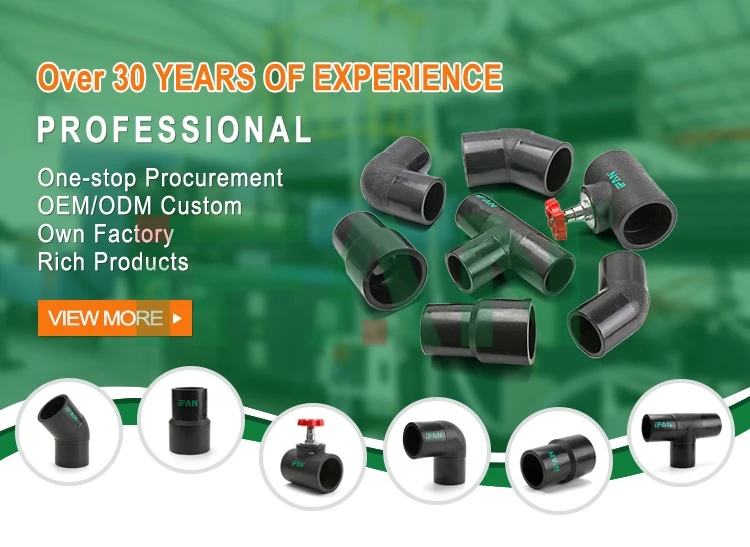
| Product Name | HDPE Butt Fusion Fittings |
| Size | 63-400mm |
| Color | Black Color Or Customized |
| Connection | Welding |
| MOQ | 100PCS |
| Sample | Sample Free |
| Contact |
Understanding the Relationship Between Butt Fusion and Maintenance Expenses
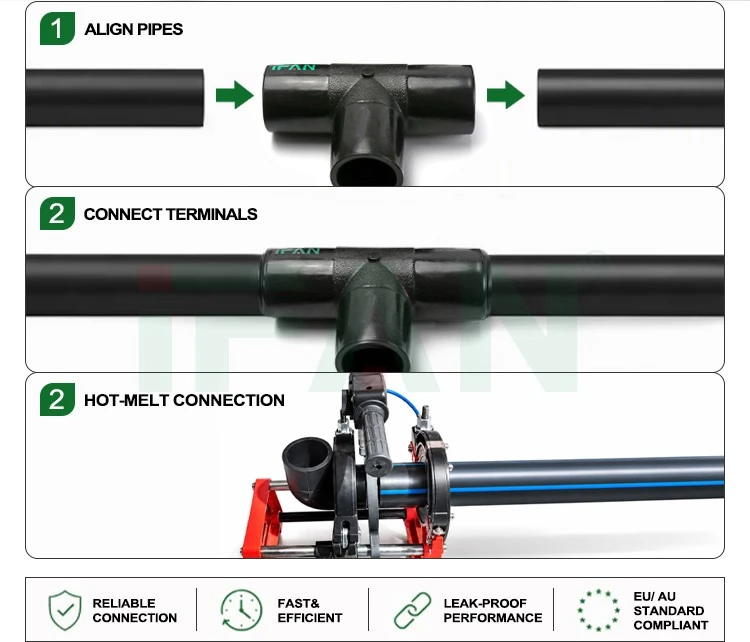
Maintenance costs in HDPE piping systems are closely related to connection quality, inspection requirements, repair frequency, and the labor needed to keep the pipeline operating within its specified conditions. HDPE butt fusion fittings connect compatible polyethylene pipes through a controlled heating and joining process. When the procedure follows the manufacturer's requirements, the pipe and fitting form a fused connection that can be assessed as part of the complete pipeline system.
Controlling Installation Labor and Equipment Use
Labor expenses depend partly on how efficiently installation tasks can be organized. Butt fusion requires dedicated equipment, adequate working space, and a defined joining sequence. If these requirements are considered during project planning, installers can position the machine, arrange pipe supports, and prepare components without repeatedly interrupting the work.
Before fusion begins, pipe ends should be cut squarely and faced to create parallel surfaces. The operator then checks alignment, confirms the heating plate temperature, and follows the specified joining procedure. Preparing materials and equipment in advance helps prevent avoidable delays caused by incorrect dimensions, contaminated surfaces, or unsuitable machine settings.
Equipment selection also influences maintenance-related expenditure. The fusion machine must be suitable for the pipe dimensions and fitting configuration, and its controls should be maintained according to the manufacturer's instructions. Calibration and routine equipment checks can help identify process deviations before they produce defective joints.
A planned installation sequence reduces uncertainty in labor scheduling and makes it easier to estimate the resources needed for future pipeline extensions or repairs.
Managing Inspection and Preventive Maintenance
Inspection costs depend on the pipeline's operating conditions, applicable regulations, and the consequences of a potential failure. A maintenance program should establish which connections require routine examination, what inspection methods are appropriate, and how frequently checks should be performed.
For butt fusion joints, visual inspection can identify irregular bead formation, visible contamination, or misalignment. However, visual appearance alone cannot confirm every aspect of joint integrity. Where required, the pipeline should undergo approved pressure or leak testing, and any additional examination should follow the applicable standards and project specifications.
Maintenance teams should document inspection results and compare them with previous records. Repeated changes at a particular location may indicate an installation issue, unexpected loading, or operating conditions that need further investigation. This approach helps direct maintenance resources toward identified concerns instead of relying exclusively on fixed inspection intervals.
Preventive maintenance schedules should also account for pressure fluctuations, temperature changes, ground movement, and other conditions that may influence pipeline performance.
Simplifying Repair Planning and Spare Parts Management
Repair costs can increase when the correct fitting is unavailable or the damaged section cannot be accessed easily. Operators should maintain accurate records of installed pipe dimensions, fitting types, material grades, pressure classifications, and connection locations. These details help maintenance personnel identify compatible replacement components before repair work begins.
For butt fusion systems, repairs typically require a suitable fusion machine, trained personnel, and enough space to prepare and join the replacement section. Depending on the pipeline layout, temporary bypass arrangements or planned shutdowns may also be necessary. Including these requirements in maintenance procedures helps teams estimate labor, equipment, and service interruption costs more accurately.
Spare parts should be selected according to the actual system specification rather than general product appearance. Differences in dimensions, material grades, or pressure ratings can prevent a replacement fitting from meeting the original design requirements. Clear inventory records reduce the likelihood of purchasing unsuitable components or delaying repairs while the correct parts are sourced.



Hot Tags: hdpe butt fusion fittings reduce maintenance costs, China hdpe butt fusion fittings reduce maintenance costs manufacturers, suppliers, factory, HDPE Compression Fittings, HDPE Elbow 90, HDPE Pipe Fitting, HDPE Water Pipe Fittings, PE Pipe, PE Pipe Fitting