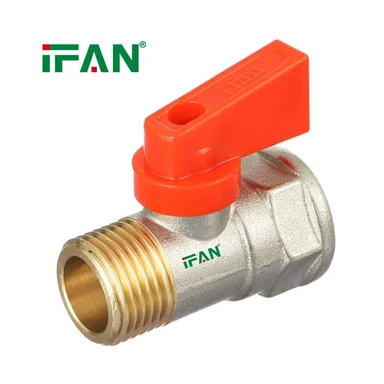

Superior Brass Pipe Fittings Improve Flow Efficiency
Aug 25, 2026


| Product Name | IFAN Brass Thread Fittings |
| Size | 1/2"-2" Or Customized |
| Color |
Yellow/White Or Customized |
| Package | IFAN standard packaging |
| Features | Durable |
| Sample | Sample Free |
| Contact | Click HERE to contact us now! |
Welcome to contact IFAN, we are online 24 hours a day to answer your questions!
Efficient fluid movement depends on more than the size of a pipe. Every connection can influence how smoothly water, air, or another fluid travels through a piping system. Poorly designed fittings may create unnecessary resistance, turbulence, or abrupt changes in direction.
Superior brass pipe fittings can support better flow efficiency through precise manufacturing and practical internal designs. When fitting dimensions match the pipeline correctly, the system can maintain a more consistent flow path. This can help equipment operate more effectively and reduce avoidable pressure losses.
Smooth Internal Passages Support Better Flow
The internal shape of a fitting has a direct relationship with fluid movement. Rough surfaces, sharp transitions, and sudden changes in diameter can disturb the flow and increase resistance.
Well-made brass fittings can provide accurately formed internal passages. A smoother passage gives fluid fewer obstacles as it moves between connected pipes. This characteristic becomes especially useful in systems where stable flow is an important operating requirement.
The fitting design also matters. An appropriately shaped elbow or transition can guide fluid through the connection without creating unnecessary disruption. Good design therefore considers what happens inside the fitting rather than focusing only on its external appearance.
Proper Sizing Prevents Unnecessary Restrictions
A fitting should correspond closely with the pipe dimensions used in the system. An unsuitable size can restrict the passage and negatively affect overall flow performance.
Correctly sized brass fittings maintain a suitable internal opening between connected sections. This helps prevent sudden reductions that could increase local flow resistance.
Installers should consider both nominal pipe size and the actual internal geometry of the fitting. Two products with the same nominal connection size may have different internal designs. Checking technical specifications can therefore help engineers select components that better support the intended flow rate.
Carefully Designed Elbows Reduce Disturbance
Changes in direction are unavoidable in many piping systems. However, every directional change can influence fluid behavior.
Elbows with suitable geometry can guide fluid around corners more gradually. This can reduce unnecessary turbulence compared with poorly configured directional connections.
The choice of elbow should reflect the application and available installation space. A compact fitting may solve a layout problem, while a different configuration may provide a more favorable flow path. Engineers should balance physical layout requirements with hydraulic performance.
Reducing Pressure Loss Across Connections
Pressure loss occurs as fluid encounters resistance throughout a piping network. Fittings contribute to this resistance, especially when a system contains many bends, branches, or transitions.
Using quality brass fittings with appropriate internal dimensions can help limit avoidable losses at connection points. This allows more of the available pressure to contribute to useful fluid movement.
Reducing fitting-related resistance can be valuable in longer pipelines and systems with multiple connection points. Small differences at individual fittings can become more noticeable when many components operate together.
Consistent Manufacturing Improves System Performance
Flow efficiency depends partly on dimensional consistency. Variations between fittings can create unexpected changes in the internal flow path.
Quality brass fittings benefit from controlled manufacturing processes. Consistent openings, connection dimensions, and internal surfaces help produce more predictable performance across multiple installation points.
This consistency can simplify system planning because engineers can work with known component characteristics. It can also reduce installation problems caused by mismatched dimensions or poorly formed connection areas.
Supporting Balanced Flow Distribution
Branching systems require careful attention to how fluid divides between different paths. Tees and other branch fittings can influence the distribution of flow.
A properly selected brass tee can provide a controlled transition between the main line and branch line. Correct sizing helps prevent one section from becoming an unnecessary restriction.
Flow balance also depends on the complete system. Pipe diameter, branch length, pressure conditions, valves, and equipment all influence distribution. Brass fittings should therefore form part of a coordinated hydraulic design.
Useful in Water Distribution Systems
Water distribution networks depend on predictable flow through multiple connections. Brass fittings can be used at transitions, branches, equipment connections, and directional changes.
Their mechanical durability supports repeated service, while their precise construction can help maintain effective flow paths. These characteristics make them suitable for many residential and commercial plumbing applications.
Actual performance depends on system design. Pipe sizing, pump capacity, pressure, fitting configuration, and water demand should all be evaluated when planning a distribution network.
Helping Equipment Receive Consistent Flow
Many systems depend on a steady supply of fluid to connected equipment. Boilers, water heaters, pumps, filters, and other devices may perform poorly when flow becomes restricted.
Suitable brass fittings can help maintain an efficient route between the pipeline and equipment connections. A correctly sized transition reduces the likelihood of introducing unnecessary restrictions near the equipment inlet or outlet.
This can support more predictable operation, particularly in systems where flow requirements remain relatively demanding.
Quality Matters More Than Material Alone
Brass itself does not automatically guarantee superior flow performance. The quality of the fitting design and manufacturing process remains important.
A poorly designed brass fitting can still create substantial resistance. Buyers should therefore consider internal passage dimensions, fitting geometry, surface quality, connection accuracy, and relevant performance specifications.
Choosing products from reliable manufacturers can provide greater confidence in dimensional consistency and application suitability.
Improving Flow Through Better Component Selection
Flow efficiency results from the interaction of every part of a piping system. Pipes, fittings, valves, pumps, and equipment must work together to achieve the desired performance.
Superior brass pipe fittings can contribute by providing smooth passages, accurate dimensions, practical flow geometry, and reliable connections. Their contribution becomes more noticeable when a system contains many connection points.
For this reason, fitting selection should be part of the hydraulic design process rather than an afterthought. When correctly sized and properly installed, brass fittings can help create efficient fluid pathways and support dependable system performance.