


Reliable Underground Networks Using HDPE Butt Fusion Fittings
Brand: IFAN
Materials:PE
Size:63-400mm
Sample: Free Sample
Service: OEM&ODM
- Fast Delievery
- Quality Assurance
- 24/7 Customer Service
Product Introduction
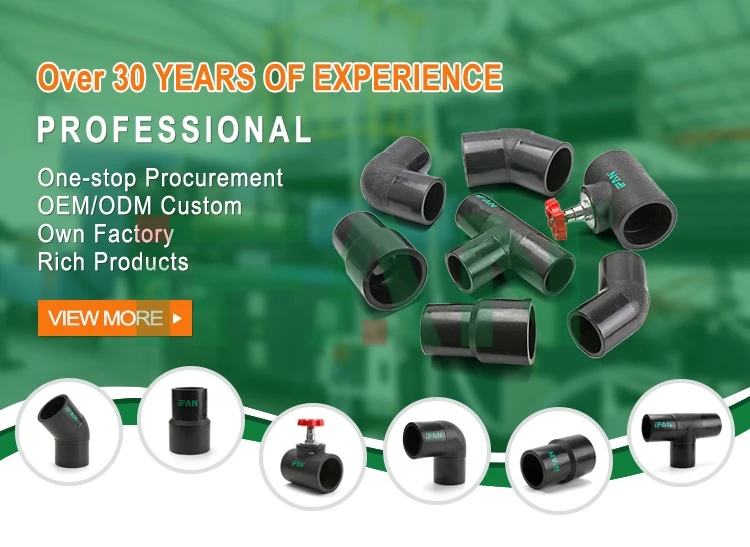
| Product Name | HDPE Butt Fusion Fittings |
| Size | 63-400mm |
| Color | Black Color Or Customized |
| Connection | Welding |
| MOQ | 100PCS |
| Sample | Sample Free |
| Contact |
Understanding the Role of Butt Fusion Fittings Underground
Underground pipeline networks provide essential connections for water distribution, wastewater collection, drainage, and various industrial services. Because these systems are installed below ground, their design must account for soil conditions, burial depth, groundwater, external loading, and the difficulty of accessing buried connections after construction. HDPE butt fusion fittings are used to connect compatible high-density polyethylene pipes and create the pipeline routes required by these underground applications.
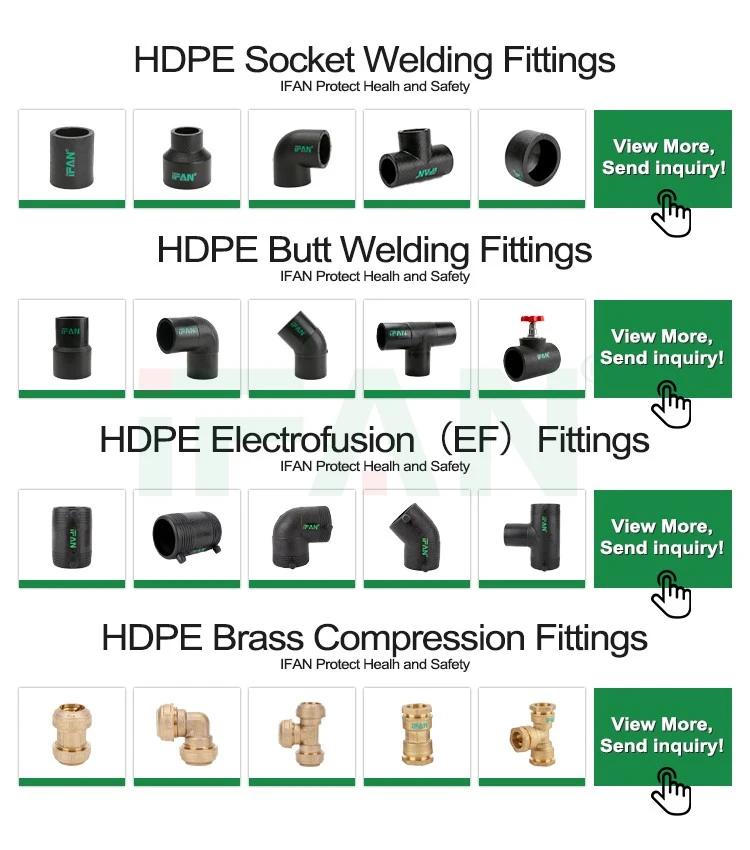
Common fitting types include elbows, tees, and reducers, each serving a specific purpose within the network. Elbows accommodate changes in direction, tees establish branch connections, and reducers connect pipe sections with different specified diameters. The selection of each component must correspond to the pipeline drawings, material specifications, and operating conditions.
Butt fusion joins prepared pipe and fitting ends through controlled heating and pressure. When the specified procedure is followed, the fused interface becomes an integrated part of the pipeline assembly. Reliable underground networks depend on correct component selection, accurate installation, suitable trench preparation, and systematic quality inspection rather than on the fitting alone.
Creating Consistent Connections Below Ground
Connection quality is particularly important in buried pipelines because direct access to a joint may require excavation. An installation defect can remain unnoticed until leakage, pressure changes, or other operational symptoms appear. For this reason, underground construction requires careful control of every stage of the butt fusion process.
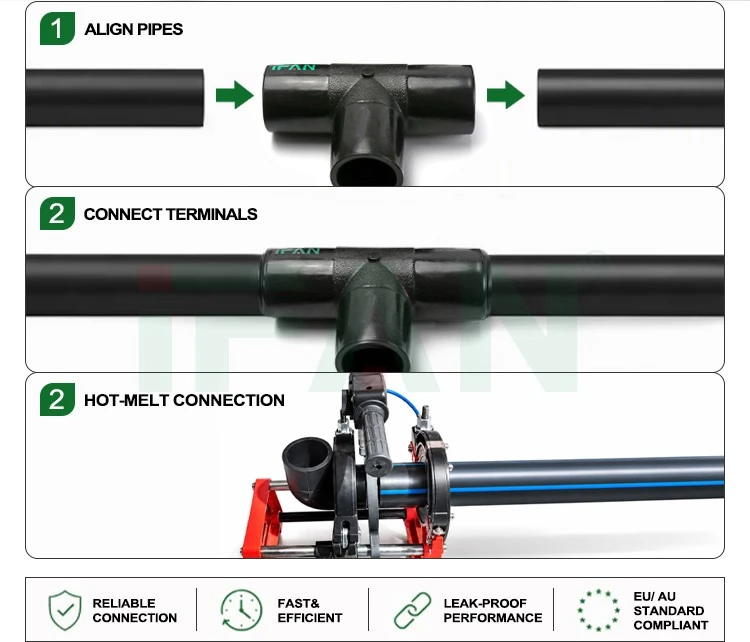
Before joining, installers prepare the pipe and fitting ends to create clean, parallel surfaces. The components are secured in a suitable fusion machine, aligned, and heated according to the approved procedure. After the heating plate is removed, the prepared surfaces are brought together under the specified joining force and held in position during cooling.
Contamination, incorrect alignment, unsuitable heating conditions, and premature movement can affect the resulting connection. These issues must be addressed before the pipeline is covered with soil. Installers should follow the manufacturer's instructions and applicable standards instead of relying solely on the external appearance of the joint.
A consistent joining procedure helps construction teams maintain uniform installation practices across long pipeline routes, where numerous connections may be required.
Selecting Fittings for Soil and Burial Conditions
Underground pipelines experience external forces that are different from those encountered in exposed installations. Soil pressure, traffic loading, groundwater movement, settlement, and nearby construction activities can all influence the mechanical conditions around a buried pipe.
HDPE butt fusion fittings must be selected according to the pipe dimensions, material grade, pressure classification, and intended service. However, the fitting specification is only one part of the underground design. Trench width, bedding material, backfill composition, compaction, burial depth, and installation methods must also be considered.
Uneven bedding or poorly controlled backfilling may create concentrated loads around a pipe or fitting. These loads can cause deformation or introduce stress into the pipeline, particularly where ground conditions change along the route. Engineers should evaluate soil characteristics and follow the project's requirements for trench preparation and backfill placement.
Where the pipeline crosses roads, foundations, or areas with variable ground conditions, additional engineering assessment may be necessary. The objective is to ensure that the buried system remains within its specified mechanical and operating limits.
Planning Pipeline Routes and Branch Connections
Underground utility networks often need to pass around existing services, follow property boundaries, cross access roads, and connect multiple supply or collection points. The route must accommodate these physical constraints while meeting hydraulic and operational requirements.
HDPE butt fusion fittings help establish the required pipeline geometry. Elbows can direct a line around an obstruction, while tees connect branch pipelines to the main route. Reducers provide transitions between specified pipe sizes where required by the design.
Before construction begins, engineers should coordinate pipeline drawings with information about existing underground utilities. Water lines, electrical conduits, gas services, telecommunications infrastructure, and drainage systems may occupy the same corridor. Accurate positioning reduces the risk of conflicts during excavation and helps establish suitable separation distances.
The route should also account for valves, inspection chambers, access points, and connections to above-ground equipment. Fitting locations need to be documented clearly so maintenance teams can identify buried components without relying on uncertain estimates. Changes made during construction should be recorded in the final as-built drawings.
Distinguishing Butt Fusion from Socket Welding
HDPE butt fusion fittings and HDPE socket welding fittings use different connection geometries and joining procedures. Understanding these differences is important when planning underground installations and selecting the appropriate equipment.
Butt fusion joins the prepared end faces of the pipe and fitting directly. A dedicated fusion machine holds the components in clamps, maintains alignment, and controls the heating and joining sequence. This method is commonly used for medium- and large-diameter polyethylene pipelines, including underground water mains and other utility networks.
Socket welding follows a different procedure. Matching heating elements soften the outside of the pipe end and the inside of a fitting socket. The pipe is then inserted into the socket to a specified depth. The installer must control heating time, insertion depth, alignment, and cooling according to the applicable instructions.
These methods are not interchangeable. Butt fusion requires accurate face preparation and controlled end-to-end contact, whereas socket welding depends on the specified fit between the pipe and socket surfaces. The fitting design determines the appropriate joining method. Underground contractors must therefore verify the product specifications before assembly rather than adapting one method to suit the other.
Controlling Installation Quality Before Backfilling
The period before backfilling provides an important opportunity to verify that the pipeline has been installed correctly. Once the trench is closed, inspecting individual connections may become more difficult and expensive.
Installers should examine completed joints for visible irregularities, unacceptable misalignment, or signs of contamination. Visual inspection can identify certain problems, but it cannot confirm every aspect of the internal fusion interface. Where required, additional examination and approved pressure or leakage testing should be completed according to the project specifications.
Testing procedures must define the required pressure, stabilization period, acceptance criteria, and safety precautions. The pipeline should not be subjected to conditions beyond those permitted by its design or the applicable test procedure.
Installation records should include relevant fusion parameters, operator details, inspection findings, and test results. Recording fitting locations and connection details also supports traceability throughout the network's service life.
Backfilling should proceed according to the approved construction sequence after the required inspections and tests have been completed. Careful placement and compaction of backfill help control external loading around the buried pipeline.
Supporting Long-Term Underground Network Management
Reliable underground infrastructure requires accurate records and a clear maintenance strategy. Operators need to know the locations of pipeline branches, changes in diameter, isolation valves, and other important components before carrying out repairs or extending the network.
As-built drawings should reflect the actual installation rather than only the original design. Records of fitting specifications, joining methods, pressure classifications, and test results provide additional information when investigating operational problems.
Monitoring should focus on relevant indicators such as pressure variations, unexplained flow changes, reported leakage, and ground conditions along the pipeline route. These signs may have several possible causes, so any suspected issue should be investigated systematically.
When extensions or modifications are planned, engineers should verify compatibility with the existing polyethylene system and reassess hydraulic capacity and operating pressure. New connections must follow the appropriate joining procedures and applicable construction standards.


Hot Tags: reliable underground networks using hdpe butt fusion fittings, China reliable underground networks using hdpe butt fusion fittings manufacturers, suppliers, factory, HDPE Compression Fittings, HDPE Pipe and Fitting, HDPE Pipe Fitting, HDPE Water Pipe Fittings, PE Pipe, PE Pipe Fitting
No Information
You Might Also Like
-

HDPE Butt Fusion Fittings Resist Abrasion Damage
-

HDPE Butt Fusion Fittings Suit Mining Applications
-

HDPE Butt Fusion Fittings Improve Water Distribution
-

HDPE Butt Fusion Fittings Reduce Maintenance Costs
-

HDPE Butt Fusion Fittings Support High Pressure
-

HDPE Butt Fusion Fittings Ensure Leakproof Connections
