


HDPE Butt Fusion Fittings Resist Abrasion Damage
Brand: IFAN
Materials:PE
Size:63-400mm
Sample: Free Sample
Service: OEM&ODM
- Fast Delievery
- Quality Assurance
- 24/7 Customer Service
Product Introduction
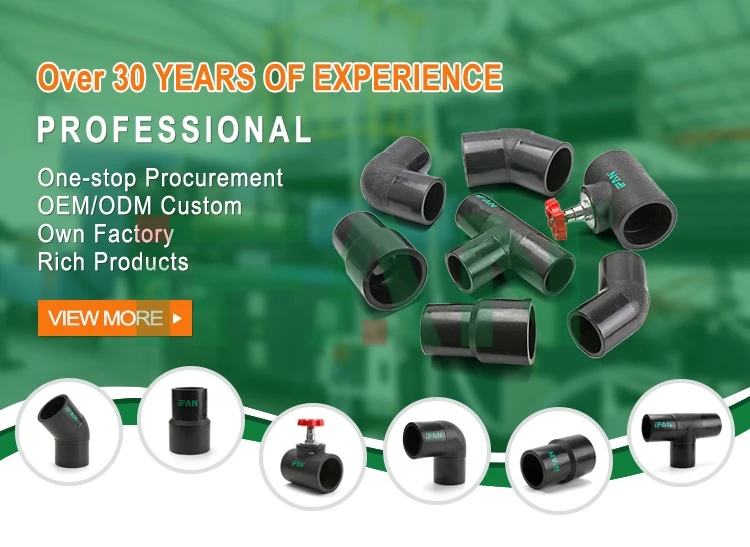
| Product Name | HDPE Butt Fusion Fittings |
| Size | 63-400mm |
| Color | Black Color Or Customized |
| Connection | Welding |
| MOQ | 100PCS |
| Sample | Sample Free |
| Contact |
Understanding Abrasion in HDPE Piping Systems
Abrasion is a form of material wear caused by repeated contact with solid particles or other surfaces. In industrial piping systems, this process commonly occurs when water containing sand, mineral fragments, sediment, or other suspended solids moves through a pipeline. The particles interact with the internal pipe wall and fitting surfaces, gradually removing material under certain flow conditions.
HDPE butt fusion fittings are used in applications where abrasive fluids must be transported through connected polyethylene pipelines. These applications may include mining operations, wastewater treatment, dredging, agricultural drainage, and industrial slurry handling. The suitability of an HDPE fitting depends on the characteristics of the transported material, including particle size, hardness, concentration, and velocity.
Polyethylene has material characteristics that influence how it responds to repeated particle contact. However, abrasion resistance is not absolute, and different operating conditions can produce different wear patterns. Understanding the relationship between material properties, flow behavior, and fitting geometry helps engineers assess where abrasion may occur and how to select suitable components for a particular application.
How HDPE Responds to Abrasive Particles
HDPE is a thermoplastic polymer with a molecular structure that allows a degree of deformation under mechanical loading. When solid particles strike or slide across its surface, the material may deform locally rather than behaving like a rigid, brittle surface. Depending on the conditions, this response can influence the amount of material removed during repeated contact.
The wear behavior of HDPE depends on several interacting factors. Particle hardness, particle shape, impact angle, flow velocity, and the concentration of suspended solids can all affect the rate of surface material loss. Sharp mineral fragments may interact with the surface differently from rounded sand particles, while higher particle concentrations can increase the frequency of contact.
Temperature and the specific polyethylene formulation also influence material behavior. Consequently, engineers should not assume that every HDPE fitting will exhibit identical abrasion resistance. Material specifications and application-specific information should be reviewed before a fitting is selected for a pipeline that transports abrasive substances.
Abrasion at Elbows and Directional Changes
Fitting geometry plays an important role in determining where abrasive wear develops. In a straight pipeline, suspended particles generally follow the main flow direction, although turbulence and particle settling may create localized contact with the pipe wall. At an elbow, the flow direction changes, causing particles to alter their trajectories and potentially strike the outer portion of the bend.
This effect can create uneven wear across the fitting surface. The severity depends on the bend radius, flow velocity, particle properties, slurry concentration, and operating conditions. Tees and branch connections may also experience localized abrasion where flow divides or changes direction.
HDPE butt fusion elbows and other fittings should therefore be evaluated according to their intended flow arrangement. Engineers may consider suitable bend geometry, flow velocity, and fitting placement when designing abrasive-fluid pipelines. Where wear is expected to be concentrated in particular locations, those areas may require closer inspection or additional monitoring.
The fitting's nominal size alone does not determine its resistance to abrasion. Local flow behavior and particle movement must also be considered when assessing likely wear patterns.
The Role of Wall Thickness and Fitting Selection
Wall thickness is an important consideration when evaluating the effects of abrasion on an HDPE pipeline. As abrasive particles gradually remove surface material, the remaining wall must continue to meet the system's structural and pressure requirements. The original wall thickness, material grade, and operating pressure all influence how much material loss can be tolerated.
Engineers should verify the fitting's dimensions, pressure classification, and compatibility with the connected pipe. For applications involving high concentrations of suspended solids, the selection process should also account for the expected abrasion rate and the consequences of local material loss.
Increasing wall thickness may be considered where the design requires additional material allowance, but it should not be treated as a universal solution. Greater thickness does not eliminate abrasion, and the final specification must remain consistent with the fitting design, fusion compatibility, and applicable standards.
Manufacturers may provide technical information or application guidance for abrasive service. Where operating conditions are unusual or highly demanding, representative testing or specialist assessment may be necessary to determine whether the selected fitting is suitable.
How Butt Fusion Differs from Socket Welding
HDPE butt fusion fittings and HDPE socket welding fittings use different connection geometries and installation procedures. These differences affect how the fittings are prepared, joined, and assessed in pipelines carrying abrasive fluids.
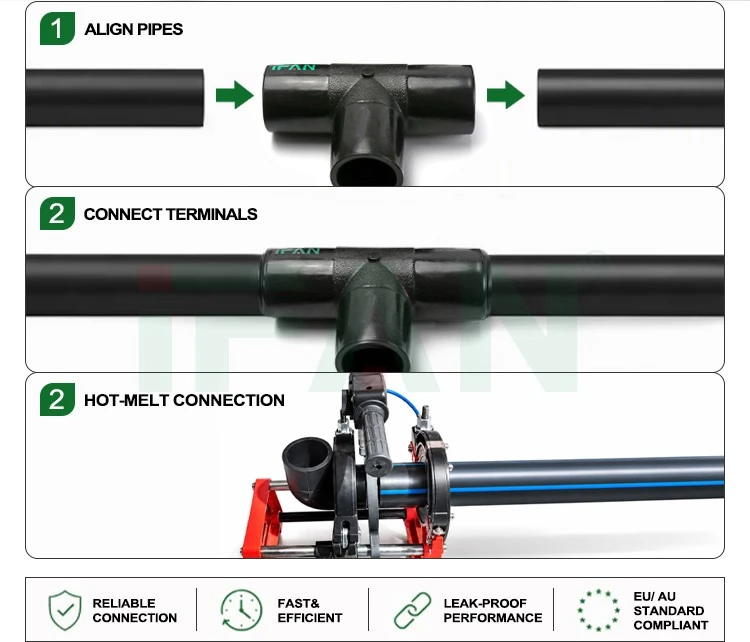
Butt fusion joins the prepared end faces of a pipe and fitting directly. A dedicated fusion machine secures the components, aligns their centerlines, heats the end surfaces, and applies the specified joining force. After controlled cooling, the connection forms an integrated section of the polyethylene pipeline.
Socket welding uses matching heating elements to soften the outside of the pipe end and the inside of a fitting socket. The pipe is then inserted into the socket to the specified depth. The joining process depends on correct heating, insertion depth, alignment, and cooling.
Neither method inherently prevents abrasion of the fitting's internal surface. Abrasion resistance primarily depends on material properties and the conditions of fluid transport, rather than on whether the joint was made through butt fusion or socket welding. The two methods must nevertheless be installed according to their respective procedures because an incorrectly formed joint may introduce separate mechanical or leakage problems.
Controlling Flow Conditions to Limit Abrasive Wear
Flow conditions strongly influence the rate and distribution of abrasion inside a pipeline. High velocities can increase particle impact energy, while certain combinations of particle size and flow rate can cause sediment accumulation in other areas. Both excessive impact and uneven solids movement may create operational concerns.
Engineers should evaluate the fluid's solids concentration, particle size distribution, density, and expected flow velocity during system design. In slurry pipelines, the flow must be sufficient to transport the suspended particles according to the process requirements, while avoiding unnecessarily aggressive conditions where practicable.
The pipeline layout should also minimize abrupt changes in direction when the process design permits. Suitable elbows and carefully planned transitions can help manage the movement of abrasive material. However, any change in fitting geometry must be checked against pressure loss, available installation space, and the hydraulic requirements of the system.
Abrasion control is therefore a system-level task. Selecting HDPE fittings without considering the fluid's behavior may leave important wear mechanisms unaddressed.
Inspection and Monitoring of Abrasion Damage
Regular inspection helps identify abrasion before material loss compromises the fitting's required operating limits. Inspection frequency should reflect the fluid characteristics, operating pressure, solids concentration, and consequences of a pipeline failure.
Where accessible, technicians can examine fittings for external damage, deformation, leakage, or other signs of a developing problem. Internal inspection methods may be appropriate for certain systems, particularly where elbows, tees, or other locations are known to experience concentrated wear.
Maintenance records should identify the fitting location, material specification, operating conditions, and inspection findings. Comparing observations over time can help engineers identify recurring wear patterns and determine whether changes to the operating conditions or inspection schedule are necessary.
Any suspected loss of wall thickness should be assessed against the applicable design requirements. Pressure testing, where required, must follow an approved procedure, but it should not be treated as a direct measurement of remaining material thickness.


Hot Tags: hdpe butt fusion fittings resist abrasion damage, China hdpe butt fusion fittings resist abrasion damage manufacturers, suppliers, factory, Compression HDPE Pipe Fittings, HDPE Compression Fittings, HDPE Pipe and Fitting, HDPE Pipe Compression Fittings, HDPE Pipe Socket, PE Pipe
You Might Also Like
-

HDPE Butt Fusion Fittings Suit Mining Applications
-

HDPE Butt Fusion Fittings Improve Water Distribution
-

HDPE Butt Fusion Fittings Reduce Maintenance Costs
-

HDPE Butt Fusion Fittings Support High Pressure
-

HDPE Butt Fusion Fittings Simplify Pipeline Installa...
-

HDPE Butt Fusion Fittings Ensure Leakproof Connections
