


HDPE Butt Fusion Fittings Suit Mining Applications
Brand: IFAN
Materials:PE
Size:63-400mm
Sample: Free Sample
Service: OEM&ODM
- Fast Delievery
- Quality Assurance
- 24/7 Customer Service
Product Introduction
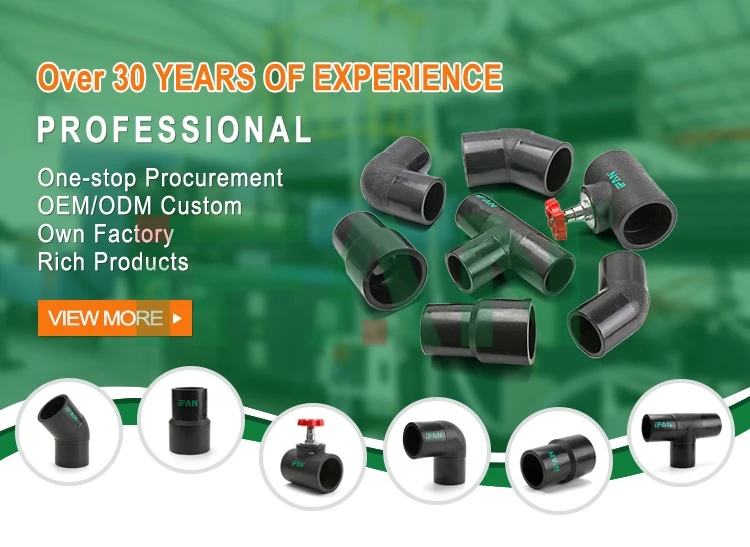
| Product Name | HDPE Butt Fusion Fittings |
| Size | 63-400mm |
| Color | Black Color Or Customized |
| Connection | Welding |
| MOQ | 100PCS |
| Sample | Sample Free |
| Contact |
Understanding the Role of HDPE Fittings in Mining Operations
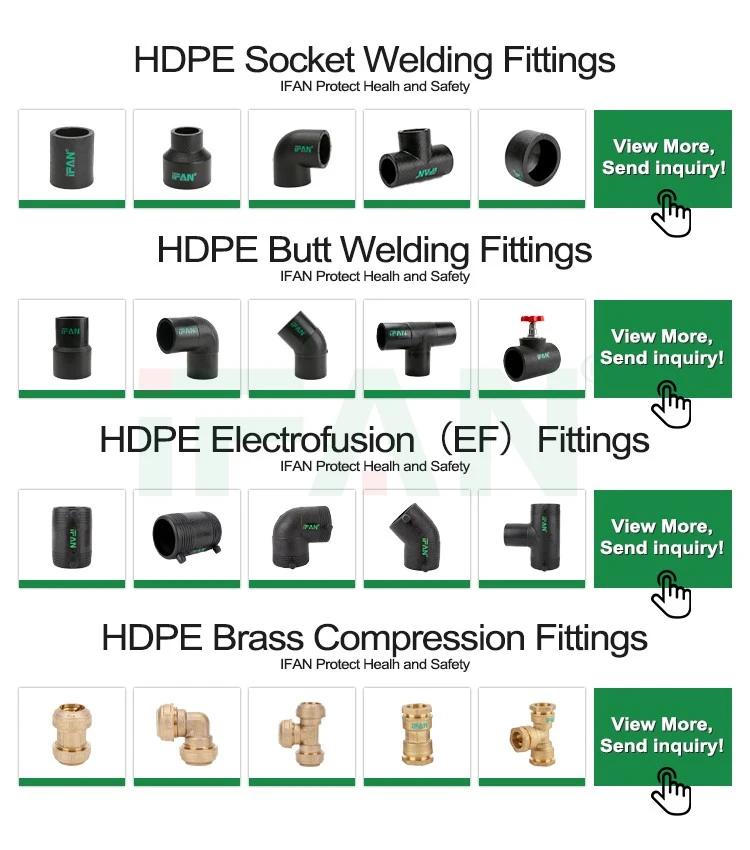
Mining operations depend on piping systems to transport water, slurry, process fluids, and wastewater between different areas of a site. These pipelines may cross uneven terrain, connect processing equipment, or extend over long distances between extraction and treatment facilities. HDPE butt fusion fittings are used to create the connections and directional changes required by these demanding pipeline layouts.
Manufactured from high-density polyethylene, these fittings are joined to compatible pipes through a controlled thermal fusion process. The pipe and fitting ends are prepared, heated, and pressed together under specified conditions. After cooling, the resulting connection becomes part of the pipeline assembly and must meet the project's mechanical and operational requirements.
Selecting fittings for mining applications requires an understanding of the transported medium, operating pressure, temperature, pipe dimensions, and installation environment. Water supply lines, tailings systems, dewatering networks, and chemical transfer pipelines may each have different technical requirements. The suitability of an HDPE butt fusion fitting must therefore be assessed against the specific service conditions rather than mining use alone.
Applications in Mine Water Supply and Dewatering
Water management is an essential part of mining operations. Water may be needed for dust suppression, equipment washing, mineral processing, and other site activities. At the same time, groundwater and accumulated rainwater may need to be removed from pits, tunnels, and excavation areas to maintain suitable working conditions.
HDPE butt fusion fittings allow compatible polyethylene pipes to be connected along these water supply and dewatering routes. Elbows can accommodate changes in elevation or direction, while tees provide branch connections to pumps, tanks, and separate work areas. Reducers can connect pipeline sections with different specified diameters when required by the hydraulic design.
The fittings must be selected according to the expected flow rate and pressure conditions. Pump discharge lines, for example, may experience operating pressures and transient loads that differ from those found in gravity-fed drainage systems. Engineers should assess these conditions before specifying fitting dimensions and pressure classifications.
Suitability for Slurry and Mineral Processing Pipelines
Some mining systems transport mixtures of water and finely divided solids, commonly referred to as slurry. These mixtures may contain sand, mineral particles, tailings, or other materials generated during extraction and processing. Their flow behavior depends on particle size, solids concentration, density, and velocity.
HDPE butt fusion fittings may be specified for suitable slurry applications when the material grade, fitting geometry, and operating conditions meet the project requirements. However, slurry service requires particular attention to erosion and abrasion. Solid particles can cause localized wear, especially where flow direction changes or turbulence increases.
Elbows and branch fittings should therefore be evaluated according to the slurry characteristics and the hydraulic design. Engineers may need to consider flow velocity, bend geometry, solids settling, and the consequences of localized wear. The chemical composition of the slurry must also be assessed because certain dissolved substances or processing chemicals may affect polyethylene under specific conditions.
A fitting that is suitable for clean water should not automatically be approved for abrasive slurry. Application-specific assessment is necessary to establish whether the proposed components meet the intended service requirements.
Distinguishing Butt Fusion from Socket Welding
HDPE butt fusion fittings and HDPE socket welding fittings use different joining configurations, and this distinction is important when planning mining pipeline installations.
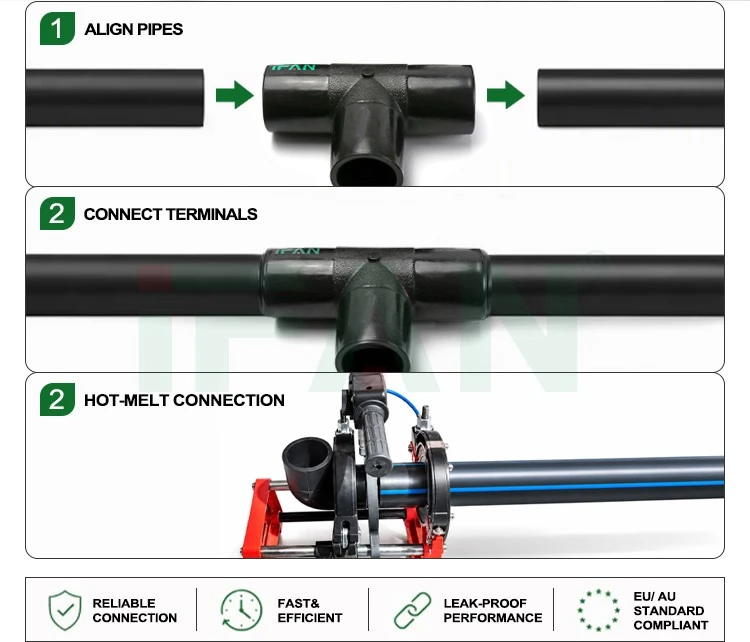
Butt fusion joins the prepared end faces of a pipe and fitting directly. A dedicated fusion machine secures the components in clamps, aligns their centerlines, and controls the heating and joining sequence. This method is commonly used for medium- and large-diameter polyethylene pipelines, including many long-distance water transfer and mine dewatering systems.
Socket welding follows a different procedure. The outside surface of the pipe end and the inside surface of the fitting socket are heated using matching heating elements. The pipe is then inserted into the socket to the specified depth. The operator must carefully control heating time, insertion depth, alignment, and cooling.
Mining projects often involve long pipeline sections, large pipe diameters, and challenging worksite layouts. Butt fusion equipment must therefore be selected according to the pipe dimensions and the available working space. Socket welding may be appropriate for compatible smaller-diameter systems, depending on the fitting design and project specifications.
Neither method should be selected solely on the assumption that it is universally more suitable for mining. The choice depends on pipe size, fitting configuration, operating requirements, equipment access, and the applicable joining procedure.
Chemical Compatibility in Mining Environments
Mining pipelines may encounter process water containing dissolved minerals, acidic drainage, alkaline solutions, or chemicals used in mineral separation. HDPE resists many commonly encountered aqueous acids, alkalis, and salt solutions under suitable conditions, but its chemical resistance is not unlimited.
The suitability of butt fusion fittings depends on the exact substance, concentration, temperature, and duration of exposure. Strong oxidizing agents, certain organic solvents, and particular chemical mixtures may cause changes in polyethylene properties under unfavorable conditions.
Before selecting fittings for chemical transfer or contaminated water systems, engineers should review the manufacturer's compatibility data and relevant material specifications. Mixed fluids require particular attention because their combined chemical behavior may differ from that of individual components.
Chemical compatibility should also be considered alongside pressure and temperature requirements. A fitting that meets the mechanical design criteria may still be unsuitable if the transported fluid can attack the selected polyethylene grade.
Managing Installation on Mining Sites
Mining sites often present difficult installation conditions, including uneven ground, dust, restricted access, changing weather, and long distances between work areas. These conditions can complicate pipe handling and fusion operations.
Before installation, contractors should prepare a work area that provides sufficient space for the fusion machine, pipe supports, heating equipment, and component movement. Pipe ends must be cut and faced correctly, and the prepared surfaces should be protected from dirt and moisture. The components must then be aligned, heated, joined, and cooled according to the approved procedure.
Long pipe sections may require additional supports to control movement during fusion. Where installation takes place near excavations or mobile equipment routes, the work plan should account for ground conditions, lifting arrangements, and site safety requirements.
Fusion parameters and inspection results should be recorded as required by the project. These records help confirm that the specified joining procedure was followed and provide traceability if a connection requires further investigation.
Pressure Control and Pipeline Inspection
Mining pipelines may experience changing pressure as pumps start and stop, valves operate, or water demand varies. Slurry lines may also experience operating conditions influenced by changes in solids concentration and flow rate. Fittings must be selected for the expected pressure range, including applicable transient conditions.
The pressure rating of the fitting must be compatible with the connected pipe and the design requirements of the complete system. Temperature-related pressure adjustments and other applicable design factors must also be considered.
After installation, joints should be inspected according to the relevant standards and project requirements. Visual examination can identify certain alignment problems and irregular fusion beads, but it does not establish every aspect of joint integrity. Where specified, approved pressure or leakage tests should be performed by qualified personnel using appropriate safety procedures.


Hot Tags: hdpe butt fusion fittings suit mining applications, China hdpe butt fusion fittings suit mining applications manufacturers, suppliers, factory, Compression HDPE Pipe Fittings, HDPE Pipe and Fitting, HDPE Pipe Compression Fittings, HDPE Pipe Socket, HDPE Water Pipe Fittings, PE Pipe Fitting
You Might Also Like
-

HDPE Butt Fusion Fittings Improve Water Distribution
-

HDPE Butt Fusion Fittings Reduce Maintenance Costs
-

HDPE Butt Fusion Fittings Support High Pressure
-

HDPE Butt Fusion Fittings Simplify Pipeline Installa...
-

HDPE Butt Fusion Fittings Ensure Leakproof Connections
-

Stainless Steel Pipe Fittings Maintain System Hygiene
