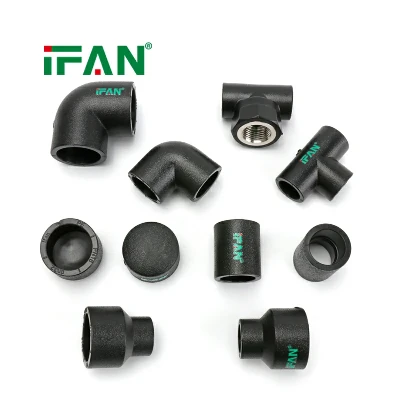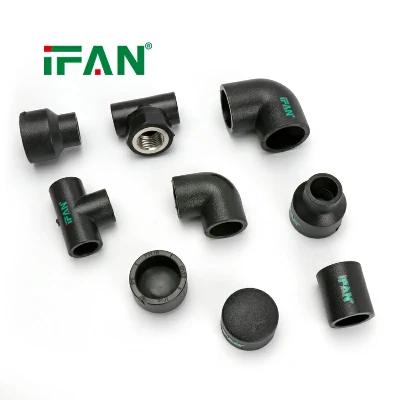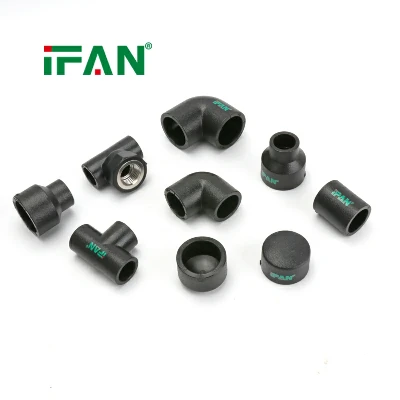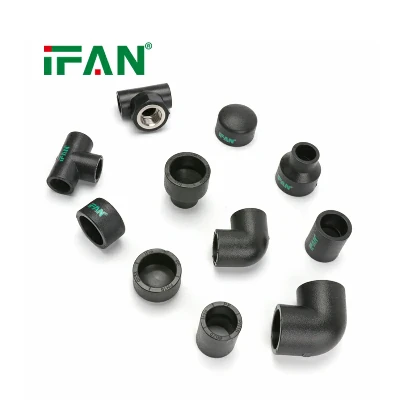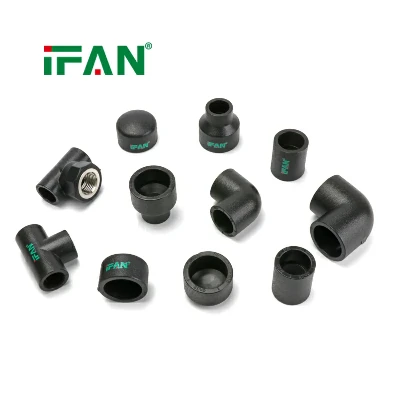

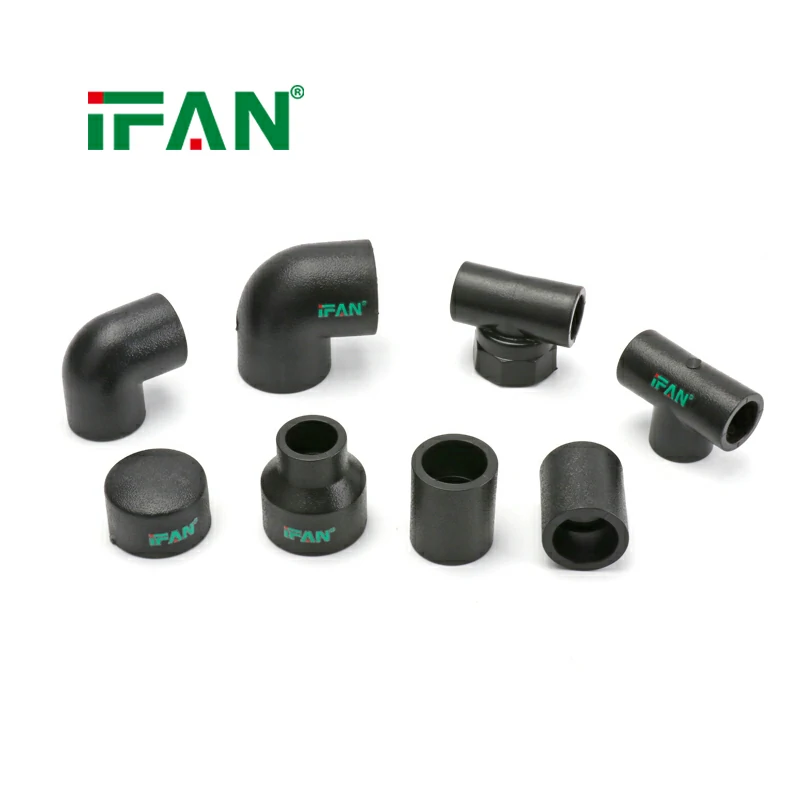

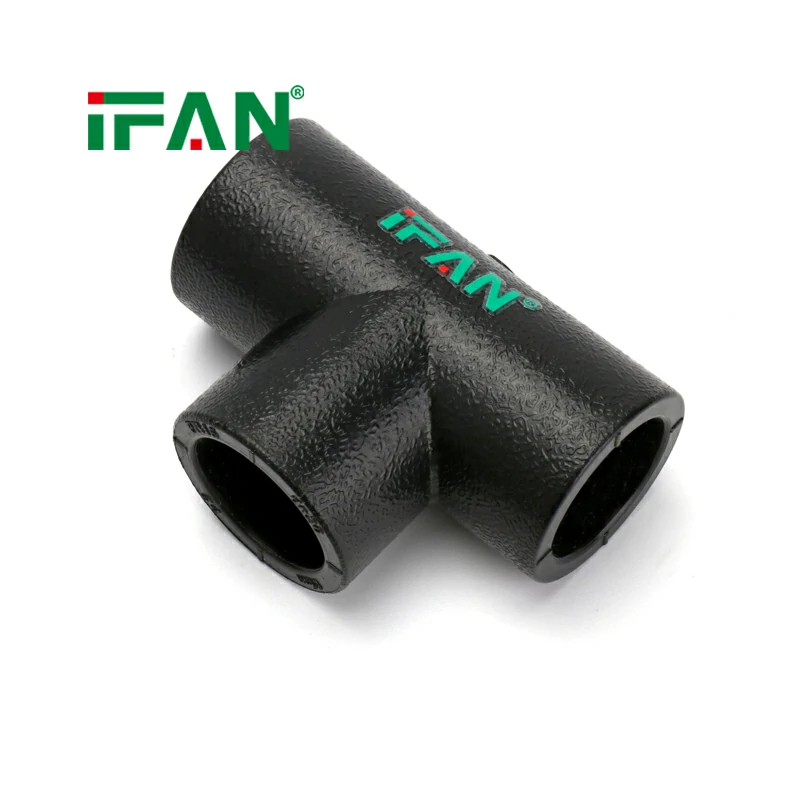

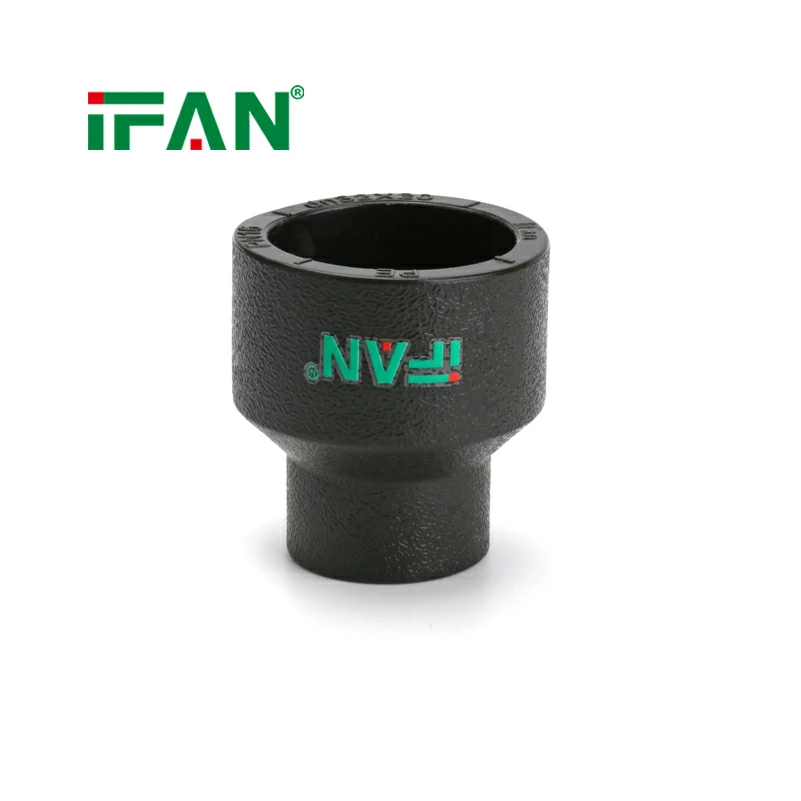
HDPE Socket Welding Fittings Enable Space Saving Connections
Brand: IFAN
Materials:PE
Size:20-110mm
Sample: Free Sample
Service: OEM&ODM
- Fast Delievery
- Quality Assurance
- 24/7 Customer Service
Product Introduction
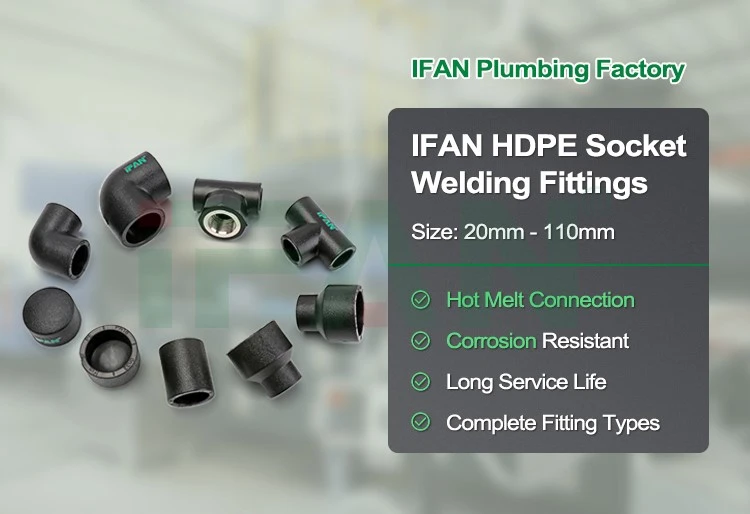
| Product Name | HDPE Socket Welding Fittings |
| Size | 20-110mm |
| Color | Black Color Or Customized |
| Connection | Welding |
| MOQ | 100PCS |
| Sample | Sample Free |
| Contact |
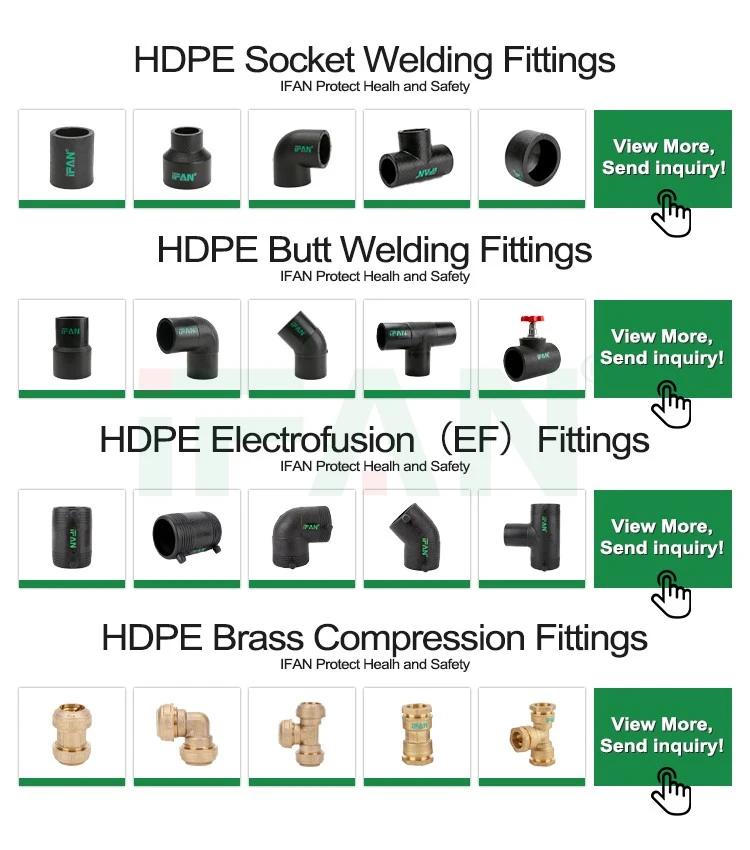
Designing Piping Systems Within Limited Areas
Space is often a major consideration when designing modern piping systems. In residential buildings, industrial equipment rooms, water treatment facilities, and agricultural installations, pipes must fit around structural elements, machinery, and other utility lines. The available installation area may be limited, requiring careful decisions about connection types, pipe routing, and fitting dimensions.
HDPE socket welding fittings provide a connection method for compatible polyethylene pipes that can be incorporated into compact layouts. These fittings connect pipe ends through thermal fusion, allowing designers to arrange straight sections, directional changes, and branch connections according to the system's requirements. Their suitability for space-restricted installations depends on the dimensions of the selected components and the clearances required during assembly.
Creating a compact piping arrangement involves more than reducing the distance between components. Designers must consider fitting geometry, socket insertion depth, pipe alignment, and access for fusion equipment. A layout that appears compact on a drawing may be difficult to assemble if the installer cannot position the heating tool correctly. Effective space planning therefore considers both the final connection arrangement and the practical requirements of installation.
Understanding the Space Requirements of Socket Connections
The dimensions of a pipe connection influence the amount of room occupied by a piping system. A fitting has its own body dimensions, socket depth, and connection orientation, all of which affect the distance between adjacent pipe sections and nearby equipment.
HDPE socket welding fittings are designed to receive compatible pipe ends within their sockets. This connection arrangement allows the pipe and fitting to be assembled directly, without requiring a separate threaded connection at the fusion interface. The actual space required depends on the fitting design, pipe diameter, and manufacturer's specifications.
When planning a compact system, engineers should use dimensional drawings rather than estimating connection lengths from appearance. The combined dimensions of the fitting and inserted pipe sections determine the overall geometry of the assembled route. Adjacent components must also be spaced so that their bodies do not interfere with one another.
These measurements become particularly important where pipes connect to pumps, filters, valves, or equipment positioned close to walls. Reviewing the complete connection arrangement before installation helps prevent unexpected clearance problems and unnecessary layout changes.
Using Elbows to Optimize Pipe Routing
Elbows are commonly used when a pipeline must change direction within a restricted area. They can guide pipes around walls, support frames, equipment housings, and other obstacles without requiring the entire route to remain straight.
In a compact installation, the angle and position of an elbow influence how much surrounding space the pipeline occupies. The designer should consider the fitting's dimensions, the length of the adjacent pipe sections, and the location of the next connection. Several closely positioned directional changes may require more space than expected if the fitting bodies or pipe ends overlap.
The route should be planned according to the actual site geometry. For example, a pipe passing beside a pump may need to turn before reaching a nearby wall-mounted connection. Selecting a suitable elbow and determining its orientation in advance helps establish a clear path through the available space.
However, the shortest route is not automatically the most appropriate. Hydraulic requirements, manufacturer instructions, equipment access, and installation clearances must remain part of the design. A carefully positioned elbow helps manage direction changes while preserving the space needed for the surrounding system.
Arranging Branch Connections in Compact Layouts
Many piping systems require one supply line to feed multiple outlets or equipment units. Tees provide branch connections that allow the main pipeline to divide into separate routes. Their position can significantly affect the overall dimensions of a compact piping arrangement.
If a tee is placed too close to a wall, another fitting, or a fixed piece of equipment, the branch pipe may be difficult to align. The installer may also lack sufficient room to position the fusion tool during assembly. These problems can be avoided by checking the branch direction and connection spacing during the design stage.
Designers should map the main pipeline first, then determine where branches must connect to serve their intended destinations. The dimensions of each tee and the required straight pipe lengths should be included in the layout. Where several branches are close together, the sequence of connections should be evaluated to ensure that each joint remains accessible.
A well-planned branch arrangement organizes multiple pipe routes within a defined area without forcing components into unsuitable positions. The final configuration must still meet flow requirements and allow each connection to be assembled according to the specified procedure.
Selecting Pipe Diameters Without Overcrowding
Pipe diameter affects the physical dimensions of a piping system. Larger pipes generally require fittings with larger bodies and greater clearance around the connection points. In confined installations, these dimensional differences can influence the placement of adjacent components.
Selecting the correct diameter begins with the system's hydraulic requirements. Flow rate, pressure conditions, allowable pressure loss, and the specifications of connected equipment determine which pipe sizes are suitable. Reducing the diameter solely to save installation space may result in excessive flow velocity or insufficient system capacity.
Where the design requires a transition between pipe sizes, a compatible reducer can provide the specified change in diameter. Its position should be chosen carefully so that the transition does not interfere with nearby connections or restrict access to equipment.
Three-dimensional layout checks can help identify potential conflicts between fittings, pipes, and structural elements. Even a simple dimensional drawing that includes fitting bodies and connection depths can reveal whether the proposed arrangement fits within the available space.
Planning Fusion Access Before Installation
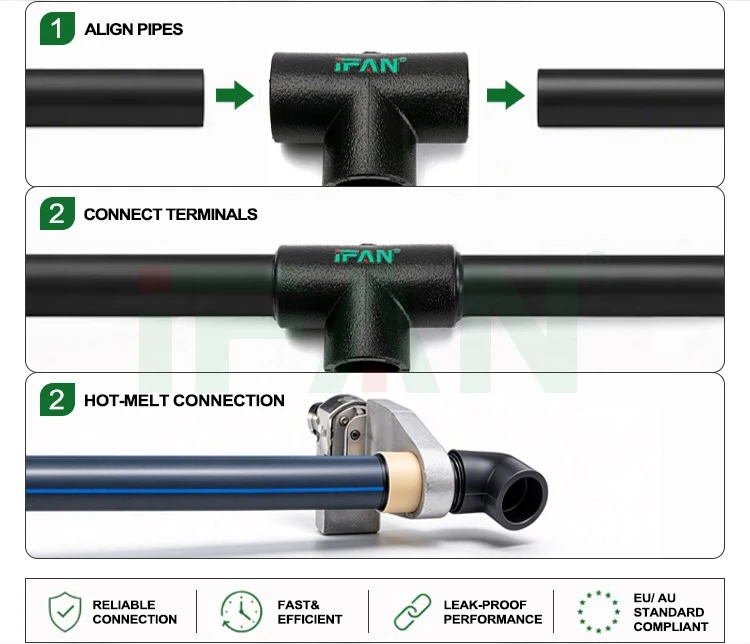
A space-saving connection must remain practical to install. Socket fusion requires room to place the pipe and fitting on the heating attachments, remove them after the prescribed heating period, and join the components without unnecessary delay.
If the pipe route is too close to an obstruction, the installer may be unable to position the fusion tool correctly. This can complicate assembly or require the affected section to be rearranged. Designers should therefore distinguish between the clearance needed by the finished pipeline and the additional clearance needed while making each joint.
In some situations, a group of connections can be assembled in an accessible work area before the section is positioned in its final location. This approach depends on the assembly dimensions, handling requirements, and the sequence permitted by the installation procedure.
The work plan should identify joints that may become inaccessible after neighboring pipes are installed. Completing these connections at the appropriate stage can prevent unnecessary dismantling and help preserve the intended compact layout.
Maintaining Access and Mechanical Clearance
Space-saving design should not eliminate the room needed for inspection, operation, and future repairs. Connections placed behind permanent structures or directly beside equipment may be difficult to examine if the layout does not account for service access.
Piping designers should leave appropriate clearance around valves, removable equipment, and other components that require periodic attention. Pipe supports must also be positioned so that they do not interfere with fitting installation or place unintended loads on socket fusion joints.
The arrangement should allow pipes to follow their intended route without being forced into alignment. Mechanical stress caused by constrained movement or poor support can affect the connection and should be addressed through appropriate design.




Hot Tags: hdpe socket welding fittings enable space saving connections, China hdpe socket welding fittings enable space saving connections manufacturers, suppliers, factory, Compression HDPE Pipe Fittings, HDPE Elbow 90, HDPE Pipe Compression Fittings, HDPE Pipe Socket, HDPE Water Pipe Fittings, PE Pipe